
On-site First Aid Treatment for Prevention and Cure of Maggot wounds in Street Animals:
It is the onset of warm weather and humid conditions that trigger an onset of maggot wound related queries on our helpline and the below treatment protocol has been shared aplenty by us through our website www.jaagruti.org, e-mail queries and blog based queries.
A horrifying number of street animals die tragic and slow painful deaths owing to maggot infestations. But, maggot wounds can be prevented and treated on site very easily (if noticed before it is too late) and these unfortunate deaths can be prevented if animal welfare volunteers read through this article below and back the knowledge so acquired with animal handling skills and some amount of patience, determination and dedication; all of which are essential qualities that are required to help heal a voiceless animal.
What are Maggots and how do they infest an animal? :
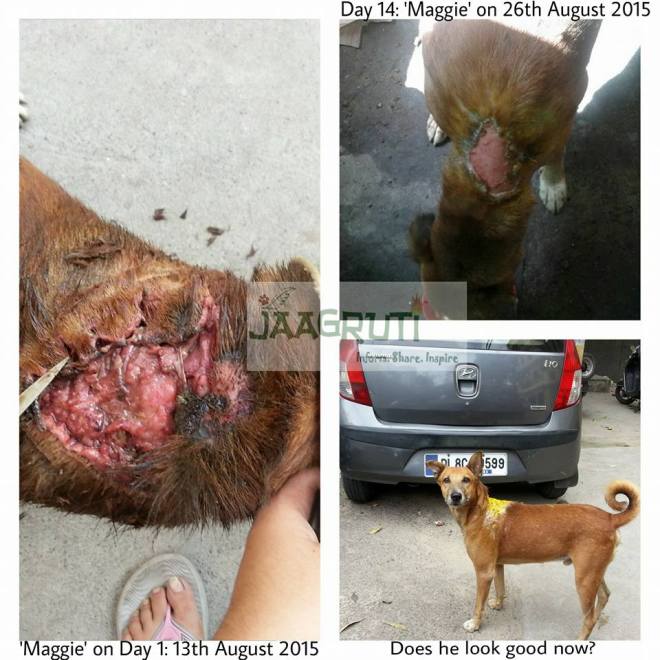
Flies get attracted to garbage, carcasses, rotting food, open wounds and faeces and use them as substrate to lay their eggs. A particular type of fly, called screwworm flies has a special fondness to lay its eggs on fresh, untreated open wounds on any animal’s body and that is what can trigger maggot infestation. These wounds could be there on an animal’s body due to a fight they might have gotten into, itching, licking, accidental injuries etc. A wound of the size of a pinhole may be enough for a fly to get attracted and lay eggs on. In areas the animal can reach with his tongue, these fly eggs are usually licked off. Danger areas for an animal where maggot infestations are common are the ears, anywhere on the head and neck, back of the body, anus.
These eggs, once laid on the wound site of an animal can hatch within a few hours into larvae or “maggots”, which start out very small just like a thin rice grain but then start feeding into the flesh and organs of any animal (be it a calf, a cat, a tiger or a dog) and then they (maggots) grow fat and up to an inch long. Alongside, they penetrate into the animal’s body and the wound increases in surface area and deepens in no time, resulting in more flies getting attracted to that side and laying even more eggs, thereby infesting it even further with maggots.
Left untreated, maggot wounds are fatal as the animal may die due to the maggots tunnelling into their brain or vital organs (depending on the site of the wound), blood loss or secondary infections.
Where and how will you see maggots or understand that the animal is infested with maggots and requires treatment?
You won’t see maggots crawling like ticks or lice on the skin surface or hair, instead what you will see is a ‘hole’ in the body of the animal and maggots crawling their way on the wound surface or inside it eating away the flesh and the most potent indicator that an animal has a maggot wound would be that you will smell rotting flesh. This stinking smell will only get worse as the maggots multiply and penetrate through the body of the unfortunate animal.
How to prevent Maggot infestation?
Prevention is surely better than cure, when it comes to Maggot wounds. Please try to understand that maggot wounds can be fatal/life threatening if not treated on time. Also, note that maggot infestations occur when any small wound on an animal’s body is left untreated and in most cases, that is where it all starts from and especially so in warm, hot and humid weather!
So, if you notice that your neighbourhood street dog/cat/cow/donkey has an open wound, follow the steps below to prevent that wound from becoming infested with maggots:
- Clean the wound site with cotton dipped in weak Tincture Iodine solution (this is stronger and works better for wound cleaning in animals). If you cannot procure weak Tincture Iodine solution, please purchase Povidone-Iodine solution (available from your neighbourhood chemist shops under brand names, Betadine, Cipladine or Wokadine etc.). This is followed by outing Nebasulf or Neosporin powder on the wound site. These powders help dry the wound and can be purchased off the local chemist shop as well.
- Then to prevent flies from sitting and laying eggs on this wound site, paste a layer of Himax, an ayurvedic veterinary fly/insect repellent, broad spectrum skin ointment (Manufactured by Ayurvet Ltd.) – on top of the wound. Himax ointment has a strong smell and pungent taste, which prevents the animals from licking it. As part of the On-site Street Animal First Aid service that we at JAAGRUTI™ run, we have also applied liberally on the wound site, a layer of another veterinary ointment, Lorexane (Manufactured by Virbac India) to promote wound healing and tissue regeneration and then topping that layer up with Himax ointment. When we choose to mix both ointments and apply them together, then the proportion of Lorexane ointment: Himax ointment was 5:1.
- For those of you who think that restraining an animal to clean their wound and apply ointments as directed in Steps 1 and 2 is difficult to execute, then you must consider investing in topical veterinary sprays like D-Mag spray (Manufactured by Intas Pharmaceuticals Ltd.) or Topicure spray (Manufactured by Natural Remedies Pvt. Ltd.), both of which help kill maggots as well as promote wound healing. Alternatively, if sprays are not available, you can invest in veterinary powders with wound healing and maggoticidal properties like Gotbac powder (Manufactured by Scientific Remedies Pvt. Ltd.) or Negasunt powder (Manufactured by Bayer) that can be directly applied on an animal/dog’s open wound.
- Please note:
- Keep repeating the above steps till the open/bleeding wounds on the animal’s body heal. It is important that we don’t take it easy on this as leaving even the tiniest bit of untreated wound would be an opening for the maggots to creep in and cause ‘destruction’!
- All veterinary (i.e. animal-specific) sprays, ointments and powders listed in Steps 2 and 3 above can be purchased only through a pet supplies shop or veterinarian’s clinic only and not at your neighbourhood chemist shop.
- Steps 1 to 3 listed above under this section are preventive in intent and will help heal an animal’s open wound and prevent flies from turning it into a horrible maggot wound.
How to treat a maggot infested wound?
Once you spot a wound-hole on the body and smell of rotting flesh in an animal, be rest assured that the smell is of maggots chewing away on the animal’s flesh. Any time wasted hereafter will only increase the maggot wound/infestation in size and prolong the animal’s suffering and pain, please ACT FAST and follow the steps below:
- KILLING THE MAGGOTS: The first objective should be to kill the maggots and to do that, we use the following options after restraining/muzzling the animal:
- Pour a capful or two of medicinal turpentine oil over the wound site. If the wound is deep seated and the only thing you see is a hole outside, then take this turpentine oil into an empty plastic syringe (without the needle) and then push the Turpentine oil into the ‘hole’. Then just let it act over the next 6-8 hours, as the medicine takes effect, you will either see the maggots popping out of the wound on the floor or large chunks of glued insects/dissolved and held together like blobs of pus coming out of the wound.
- However, if you can’t find Medicinal Turpentine oil at the chemist’s shop…then please remember – DO NOT PUT Painter’s Turpentine oil/kerosene oil/petrol/phenyl etc.into the maggot wound. We have noticed that, ignorant of the above fact, a lot of people residing in slums or villages and even otherwise in cities do put all of these into a maggot wound which they should NOT DO; because the sheer toxicity of phenyl, petrol and kerosene can prove fatal and burn the good tissues of the animals, especially in sensitive areas like the head, ear (these chemicals can reach the brain through these organs). So our suggestion is that in case you don’t find Medicinal Turpentine oil, invest in maggoticidal (i.e. maggot killing) veterinary sprays like D-Mag spray or Topicure spray and then place it as close to the maggot wound site and then spray it in hard 4-5 times or even more as required. Doing so will have the same effect as those described above post-application of Turpentine oil. This part of the treatment (Steps 1 a. and 1 b.) will cause pain to the animal, but for their own welfare it is necessary that you use it. Please remember, the burning sensation will pass, but if unattended, the maggots will kill the animal.
- REMOVING DEAD MAGGOTS: Check the wound to see if the maggots show signs of life. Even when you think you have removed all the maggots, inspect the inside of the wound thoroughly with a torch. Maggots often create tiny tunnels leading from the main wound deeper into the body of the dog. You may not see the maggots in these tunnels. One giveaway is that the bloody fluid in the hole/holes will appear to be moving, literally “breathing,” if you watch carefully for a few minutes. A common error is not waiting long enough to observe this movement. As a precaution, even when you think you have removed all the maggots, spray the inside of the wound with the D-Mag or Topicure sprays. The pungent Turpentine/eucalyptus oil smell will irritate the maggots and they will start emerging from the tunnel. Once you think they are dead and if you are brave and determined, take a sterile tweezers/forceps to remove/pluck out the dead maggots from the wound. Do remember to clean the tweezers/blunt forceps with antiseptic solutions like Spirit /Savlon/Dettol solution prior to use.
- CLEANING THE WOUND: Keep clean cotton wool handy and dip it in weak Tincture Iodine solution or Povidone Iodine solution to disinfect the wound site.
- WOUND DRESSING:
- Put Negasunt or Gotbac powder into and over the wound.
- Next step is to liberally apply Lorexane ointment and layer the wound surface or fill up the hole/wound with this. As stated earlier, in this article, Lorexane cream helps heal the damaged wound site by promoting tissue regeneration, while also keeping the flies away.
- The most important step at the end is to apply Himax ointment liberally over the wound site to prevent any more flies from sitting on the wound and re-infesting it further with maggots.
- Slowly in a few days, fresh skin will start appearing and the open and wide maggot infested wound will heal and you will be glad that your little effort and investment helped save a life for sure…as maggot infestations don’t go away or cure or heal on their own, human intervention in the ways described above are absolutely essential!
- Remember to keep repeating the above steps till the wound heals, with a periodicity of 12-24 hours at the start of the treatment and then every other day till the wound heals and seals itself. Treating maggot wounds requires loads of patience, they don’t heal overnight, so please keep up the good work till the animal has healed completely.
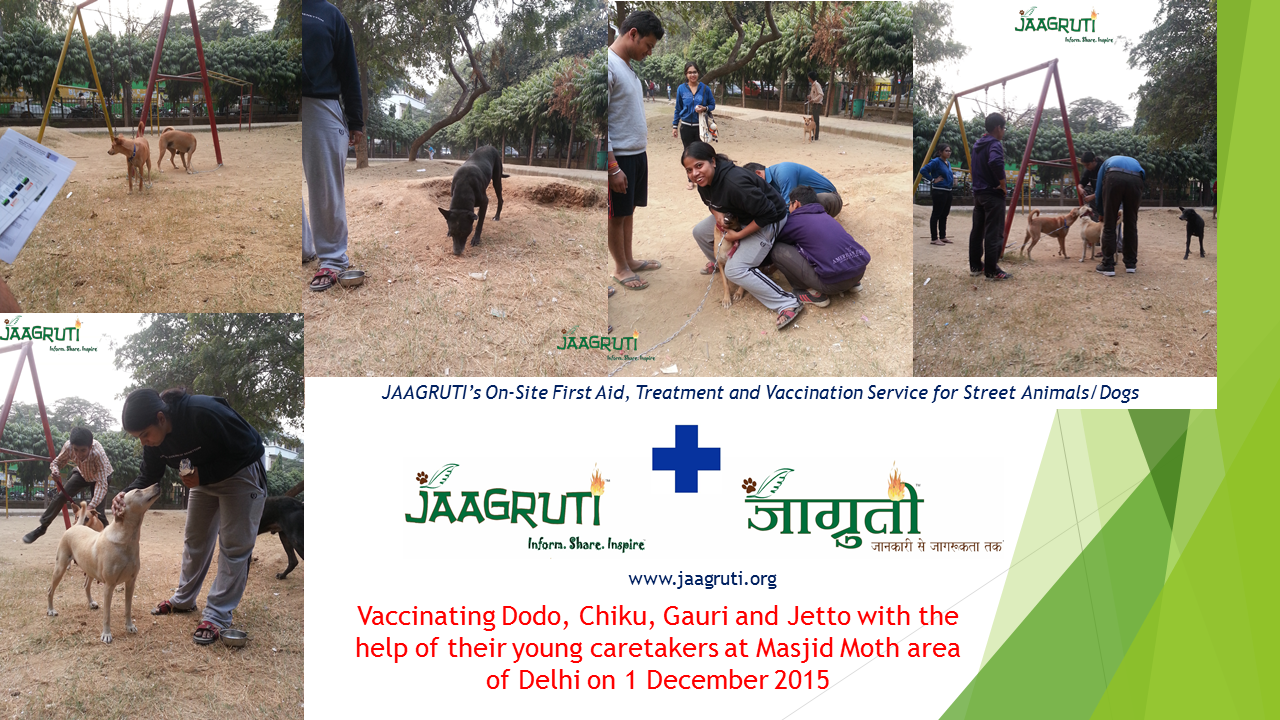
We believe following the above steps does help and over July 2014 to November 2014, as part of the On-site First Aid Service for Street Animals that we at JAAGRUTI™ run in North West Delhi, we have followed the steps detailed in this article to treat on-site (i.e. on the very streets these animals live) 24 animals with maggot infested wounds. This included 2 donkeys and 22 dogs and depending on the severity of wounds, it has taken us 2 weeks to 4 weeks to treat all animals. We have been able to do this only because people from the community, where this maggot infested animal was being treated came forward to handle the animal while our team, was administering treatment; and also ensured that the wounded animal was being fed well to help speed up their recovery. From our end, after doing topical treatment to clean and dress the maggot wound, we were also using assistance from trained veterinary professionals to inject the required dosage of antibiotics, Inj. Ivermectin and multivitamins to kill deep seated maggots, minimise infections and promote wound healing. Please consult your local veterinarian and use tablets and syrups mixed in feed to substitute for injectables.
Do let us know if the above works for you too.
Please refer to this Slideshow on Treatment of Maggot Wounds in Dogs
By Vasudha Mehta, Co-founder & Trustee, JAAGRUTI™:


















 Last week, thanks to the initiative of the Principal of D.A.V Public School, RK Puram, Mrs. Sanjana Dutta, we were invited to conduct an Awareness Workshop on ‘Compassionate Citizenship’ for students of Class 4th and 5th. Our objective while conducting such awareness workshops is to inculcate within these young students, who are at such an impressionable age, empathy and respect for all living beings and the resources, Mother Earth offers us. These kids, learnt how they could go about caring for animals on the street, in the wild, about being sensitive towards our lifestyle choices and the Environment we co-inhabit with all other species, in our day to day lives.
































 JAAGRUTI® -