This photo of a ‘young baby goat’ (referred to as a ‘kid’ in proper English language) tied to the side of a temple railing-waiting to be sacrificed was shared with us by Mr. Satish C. Gupta, an Agra resident. It was clicked on his recent visit to Kamakhya Temple in Guwahati, Assam.
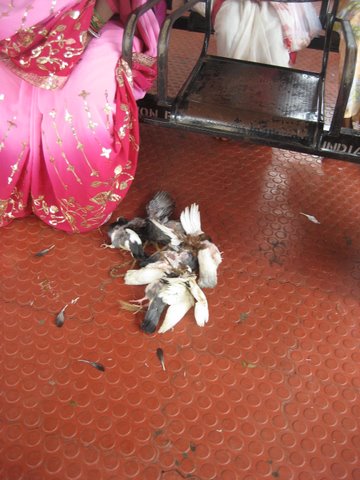
He also shared with us another photograph clicked at this temple which shows the remnants of a recently sacrificed bird lying on the floor of this temple.
Kamakhya temple, Guwahati (Assam, India)
On the floor: Remnants of a bird sacrificed at this temple
It is strange that in a progressively developing country like India, the practice of sacrificing animals for religious reasons, in the hope that doing so will please the deities and grant a person’s wish! And we learn that Animal Sacrifice is legal in Bengal and Assam, that is why perhaps we see the shots like the ones above from Kamakhya Temple (located in Guwahati, Assam).
To learn more about the practice of Animal Sacrifices in India, their legal angle and what you can do to help stop it, please have a look at the video below.
But there are laws banning animal sacrifices in many states across India and also national laws, and the reason these laws are not being enforced is because the authorities are as ignorant of the laws as much as we are, so this puts all the more responsibility on us to inform people of the laws and inspire them to use them tactfully for the benefit of animals and also share these with the authorities and educate people alike to put an end to the archaic and cruel practice of ‘Animal Sacrifices’.
Click on the link below to download this PDF file to make yourself familiar with Animal Protection laws in India. Share this booklet with your neighbourhood Police Station too, its important we spread the word around on these largely unknown laws.
Click on this link that would lead you to a Dossier on animal protection laws for the guidance of police, HAWOs(Honorary Animal Welfare Officers), NGOs AND AWOs(Animal Welfare Organisations), that contains a compilation of Frequently Asked Questions answered thematically
Other useful resources are as follows:
Animals and the Law: A Powerpoint presentation by Advocate Ms. Aparna Rajagopal
The Indian PCA Act 1960: PDF File of The PCA – Prevention of Cruelty to Animals Act 1960, a central act.
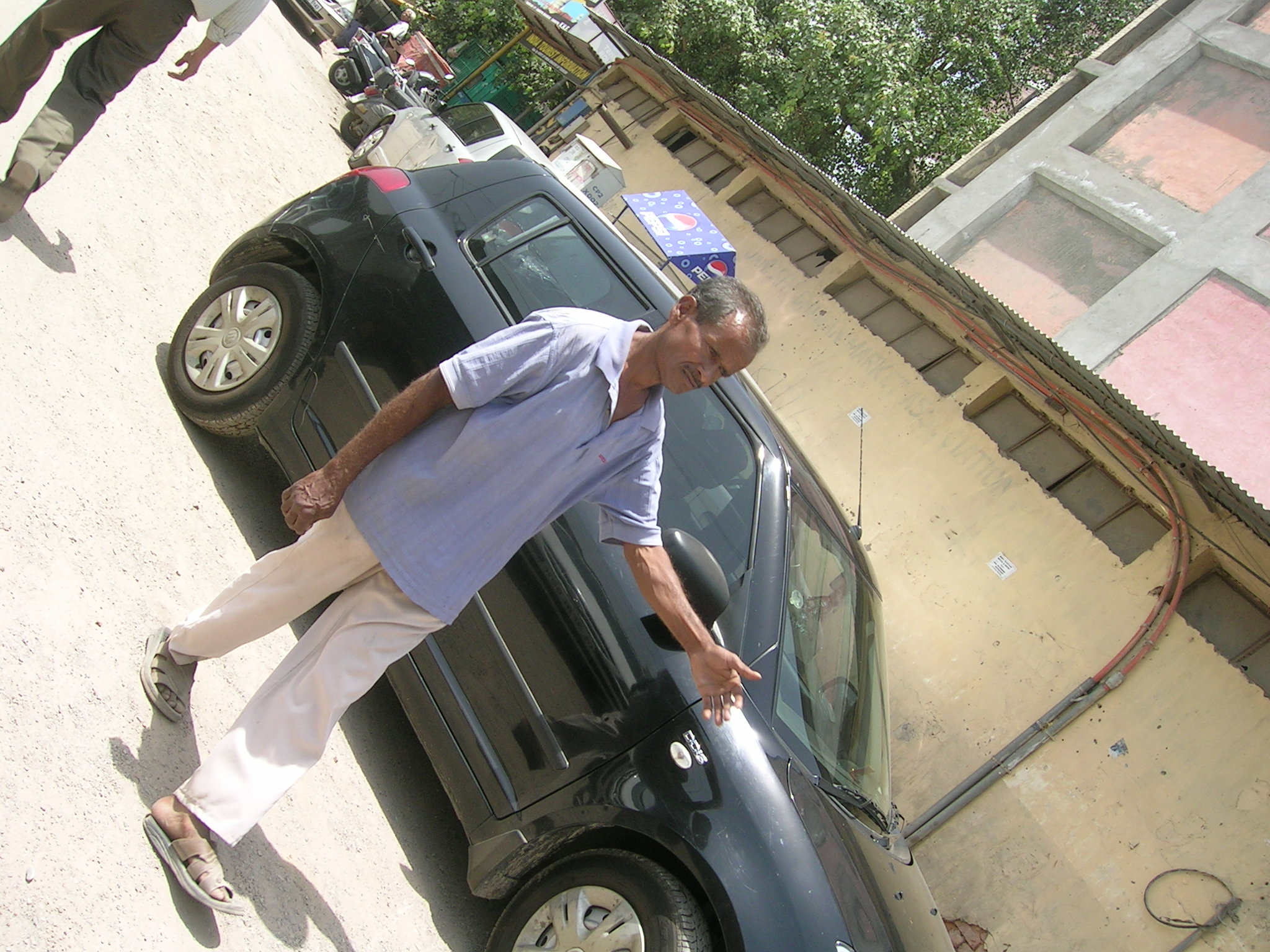
We don't know his name but, he is 'deaf and dumb' and he has been manning this car park at Janpath lane for the past thirty years.
Janpath is one street market in that needs no introduction to anyone visiting Delhi, but perhaps the car park at Janpath Lane needs an introduction of some sorts.
Janpath Lane is perhaps the only lane in Central Delhi’s Connaught Place region which is not under NDMC’s (New Delhi Municipal Corporation) Parking Rates and Regimes for what we believe are reasons emanating out of a spirit of both, humanity and generosity. Because this lane, adjacent to the Janpath shopping centre on the lane opposite the famous Saravana Bhawan eatery is being manned for the past three decades by a team of five ‘deaf and dumb’ men…There are no parking tickets in here (neither manual nor computerised), no fixed parking rates either, you can give as much as your heart desires and the wallet allows.
In case there is a difficulty in communicating with a member of the public or a person who has parked their car in there, then these men are aided by a few fruit sellers sitting on the corners of the lane, who have, after all these years of sharing the same ‘place’ (or ‘street’) of work, learnt to communicate with these ‘differently-abled’ parking attendants in sign language
The man in the photograph above is the oldest member in this 5-member team of parking men. He has been here for 30 long years. He uses his hands to guide people to park their cars in and out of this lane and keeps a watchful eye on the cars he takes charge off, similarly with the rest. We learnt through the street shop vendor (selling shoes at the Janpath street market that begins next to this lane) that this old man has been able to educate his children and marry off his daughters into good homes all through the money he has earned at this car park with honesty and hard work in all these years. Try trusting him and his colleagues to take care of your car when you next head to good old Janpath for your season’s street shopping.
“Disability is a matter of perception. If you can do just one thing well, you’re needed by someone.”- Martina Navratilova
The Janpath Lane Car Park
Scott Hamilton once said, “The only disability in life is a bad attitude.”
So, lets ‘try’ to treat all beings, humans or animals, plants or insects, abled or dis-abled with respect if not love and care, for in this vicious circle termed ‘life’ what goes around does indeed come around.
Photograph by Tapan Mukherjee, courtesy Aajkaal, a Bengali daily (Dated 25th May 1996)
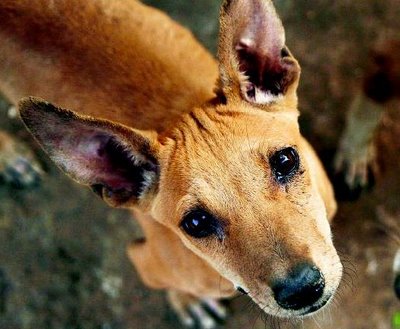
Photograph above: Three street dogs protecting a new-born baby abandoned in Kolkata on the evening of 23rd May, 1996. Below is an excerpt of a news report filed by Pinaki Mujumdar on the 25th May, 1996 edition of a Bengali daily, named ‘Aajkaal’ which carried the above hear-rendering photograph by Tapan Mukherjee.
This story was carried on the front page of this newspaper and did end up demonstrating the responsible ‘humane’ action of these three street dogs towards a human baby.
This is one of the best examples of sensitive journalism that was accompanied by sharp news sense.
A bright new born baby girl by the side of the dustbin. Sitting around her are three street mongrels. The same unchanging picture throughout the night. This unbelievable and inconceivable incident is not a scene from a screenplay. Nor is it the background to a story causing a sensation throughout the world. It is real-as unalloyedly real as light and air, life and death.This incident stretched at Hartokibagan Lane under Burtolla Police Station from the night of 23rd May, 1996 to 24th May, 1996 morning. Not just that, the three dogs followed like responsible guardians when some people of the locality rescued the new born baby girl and took her to the Burtolla Police Station. They had, unnoticed by all arrived at the door of the Officer-in-charge at Burtolla Police Station I.K Hossain as people were busy watching the baby, who had been put on the officer’s table, move her hands and feet. This scene did not elude the eyes of the policemen and the curious people present at the police station.
This report states that it was only around 2 pm on 24th May, 1996 , when the baby was put in a car to be taken to a f home for foundlings did these three street dogs walk back to their old neighbourhood, walkng slowly….
(Courtesy: Savage Humans and Stray Dogs, a book by Hiranmay Karlekar, Sage Publications 2008)
Hands that help are better than lips that Pray! (Image Courtesy: Helping Hands-http://www.fsgp.org/storage/HH_Image.jpg)
Volunteer to provide quick medical relief to the dog who guards your street
A horrifying number of dogs and cats die because of lack of medical attention. This is all the more tragic because wounds and injuries are surprisingly simple to treat, once you’ve learnt how. Especially for very serious cases, the dog does not even need to be hospitalized. With your help, street dogs can live a happy and healthy life. Some of the most common problems that street dogs suffer from are skin infections, wounds and maggot wounds. All these can be treated easily on site, unless of course the symptoms or the injury are very severe when the dog needs to be taken to a vet or a shelter.
* Please note: This page will be regularly updated in both Hindi and English language for the benefit of those who care for their community dogs. However, it is to be noted that the information written in there is for informative purposes only. We request you to please do contact a veterinary doctor or take the animal to a shelter for thorough treatment if symptoms look grave.
For further queries or guidance, please write to us at contact@jaagruti.org or call on our helpline +91-9818 144 244
First Aid Kit:
Scissors, forceps, thermometer, chain to restrain the dog, tape to muzzle the dog (or buy a regular muzzle from a vet), adhesive tape, Gauze Bandages, cotton wool, bandages.
Medicines: Betadine Lotion and Ointment, Neosporin or Nebasulf powder, Himax Ointment (a miracle medicine for animals) or Skinoment, Betnovate Skin Cream, Soframycin skin ointment, Ivermectin – 10 ml vial, Topicure spray, Scabnil Oleo, Neem oil, antibiotic such as Cifran 500 mg (for 20 kg dog), Avil tablets (25 mg or 50 mg -depending on the age and weight of the dog), Petmosol soap, Ecktodex or Ridd, Ivermectin tablets, sulphur powder, camphor powder, boric powder, coconut oil, kerosene oil, Cetrimide Lotion (Anti-allergic wash from Piramal Healthcare)
SKIN DISEASESThis is the most common problem that dogs suffer from. In the first instance, try and avoid them getting skin infections by taking precautions. Give a pinch of sulphur in the dog’s food once a week. You can also give a neem tablet (from Himalaya Drug Co.) once a week which is most effective too. If we can help treat their skin infections, it would eliminate a great deal of suffering the dog undergoes. The most common diseases are mange and scabies and fungal infection. Most dogs can be treated at site. There are various treatments:
Treatment 1 (allopathic treatment)
If possible, give the dog a bath with Petmosol soap. (Repeat once a week till the dog heals).
Apply Ektodex 1 tsp in 1 litre solution (or as instructed on the bottle). Note: As this medication is poisonous, do not let the dog lick himself. Try and walk the dog till the medicine dries.
Antibiotics have to be prescribed as the constant scratching will have caused bacterial infections. Amoxycillin can be given 2 times a day for three days along with Vitamin B capsules. Avil can also be given to relieve the itching.
Treatment 2Do not apply this mixture on cats.
Mix Scabnil Oleo with an equal part of Neem oil.
Apply on the dog with a brush. Repeat every 4 days.
The main ingredient of Scabnil Oleo is karanj oil which is a powerful anti-fungal agent. Neem oil is also strongly anti-fungal.
Treatment 3(Home remedy)Warm Coconut oil and mix 10 cubes of camphor (camphor packet available in the market) and 1 tsp sulphur powder in it. Then put in 1 tsp Boric powder in it and then kerosene oil and cool the mixture. Apply the mixture on the dog’s skin, so that it reaches the hair roots. (You can clip the hair if you cannot reach the roots. You can keep this mixture in a small glass bottle and repeat it until the dog is healed.
Some general points for skin diseases.Treatment 2 is very effective for parasitic skin disease like mange or scabies. In general we have found Treatment 3 to be very effective in heat-related skin problems. This is because of the cooling properties of camphor. At the time of application this treatment may irritate the skin and make the dog restless, but this will pass off in an hour or two. Usually dogs do not try to lick these ointments because of the strong smell. However, to be on the safe side it might be a good idea to keep the dog muzzled during application.
WOUNDS (Prevention of maggot wounds)
You may be lucky enough to spot a wound before a housefly does. Do not neglect even a small wound especially if the dog cannot reach it to lick itsince they are the ones which very quickly become maggot infested. A gaping wound, however, is going to require stitches and the dog would be required to be taken to the vet. If it doesn’t, then you can treat it yourself.
2. Sprinkle Neosporin (or Nebasulf) powder liberally into the wound.
3. Put Himax on the wound liberally to keep away flies so that it doesn’t become a maggot wound. If the dog has a caretaker, try leaving Himax with him and tell him to apply it on the wound everyday until it heals.
MAGGOT WOUNDS. An open, round and deep wound with bleeding and which also gives out a foul smell are usually clear indication of a maggot wound (see image). Since it is a painful procedure, the dog must be muzzled when it is being treated. Do not treat head wounds but take the dog to a vet or a shelter.
You can also spray Topicure deep into the wound so that it irritates the maggots to emerge out. If maggots start to emerge, remove them with tweezers.
Then apply Nebasulf or Neosporin powder into the wound to heal and dry it. Next apply Lorexane cream and fill the wound with this.
The final and most important layer is the ayurvedic fly repellant Himax cream. Apply it liberally all over the wound so that flies do not get to the wound again.
The next day if you can treat the wound again, you will need to repeat the same steps again.
Once the wound is a pink colour, you can just sprinkle Neosporin powder in the wound and apply Himax liberally on top of it until it heals.
How to tie a muzzle to treat a dog?
Use a long strip of material or a tape (not adhesive or any sticky tape, please)
Place the strip of material on top of the dog’s nose.
Loop the material under the dog’s chin and tie it into a knot.
Bring the ends of the material back behind the dog’s ears and tie into a bow on top of the head.
Remember: Use the muzzle only for treating a dog for a few minutes as the dog can get overheated.
If you have more time at hand, please watch the videos below (uploaded on You Tube by Voice of Stray Dogs) and listen to Dr. Pavan, Founder of Cessna Lifeline Veterinary Hospital in Bangalore. He explains in this two part series as to how to attend to and intervene effectively on Medical emergencies in Animals
* Please note: This information is for informative purposes. Please do contact a veterinary doctor or take the animal to a shelter for thorough treatment if symptoms look grave. For further queries or guidance, please write to contact@jaagruti.org or call us on +91-9818 144 244
First Aid for Dogs- text translated in Hindi can be read below
कुत्तों के लिए प्राथमिक चिकित्सा
सड़क पर रहने वाले कुत्ते और बिल्लियाँ अक्सर उपचार के आभाव में मारे जाते हैं, यह बात बहुत दुखद: है, क्योंकि उनकी मृत्यु का कारण रहे घाव व चोटें आश्चर्यचकित रूप से बहुत आसानी से ठीक किये जा सकते हैं, एकबार आप ने सीख लिया की यह उपचार कैसे किया जाए विशेषतः कुछ गंभीर स्थितियों में, जब कुत्ते को अस्पताल में रखने की जरुरत नही होती, आप सडकों पर रहने वाले कुत्तों की सु:खद व स्वस्थ जीवन जीने में सहायता कर सकते हैं|
त्वचा सम्बन्धी संक्रमण, घाव व कृम घाव वे सामान्य समस्याओं में से कुछ हैं जिनसे सड़क पर रहने वाले कुत्ते सबसे अधिक पीड़ित होते हैं| इन सभी समस्याओं का आसानी से यथा स्थान उपचार किया जा सकता है (यद्यपि ये इतने गंभीर न हों की कुत्ते को पशुचिकित्सक या आश्रय स्थल में ले जाने की जरुरत हो )
प्राथमिक चिकित्सा किट (विषय-वस्तु):
एक बार आपके पास प्राथमिक चिकित्सा किट का सारा सामान हो तो आप किसी भी जरूरतमंद कुत्ते को समय पर चिकित्सा उपलब्ध कराने के लिए तैयार हैं | नीचे दी गई औषधियाँ साधारण रूप से कुत्तों के लिए हैं, और संग्रह करके भविष्य में उपयोग के लिए रखी जा सकती हैं | यह सभी औषधियाँ किसी भी पशु-औषधि विक्रेता के पास उपलब्ध होती हैं |
कैंची, चिमटा, थर्मामीटर, कुत्ते को बंधने के लिए चेन, कुत्ते का मुहं बंधने के लिए फीता (और पशु चिकित्सक के पास उपलब्ध नियमित मज़ल टेप खरीदें), चिपकने वाला टेप, गाज़, पट्टी रुई व टॉर्च. दवाइयाँ:: Betadine Lotion, Nebasulf or Neosporin powder, Himax Ointment (पशुओं के लिए एक चमत्कारी औषधि), turpentine oil and chloroform mixture), Topicure spray, Scabnil Oleo, neem oil, antibiotic such as Cifran 500 mg (for 20 kg dog), Avil tablets, Petmosol soap, Ecktodex or Ridd, sulphur powder, camphor powder.
घाव (बचाव कृम/मगट घावों से) आप भाग्यशाली होंगे यदि आप घाव को घरेलु मक्खी से पहले देख लें, छोटे से घाव को अनदेखा न करें यही घाव जल्दी कष्टदायक
इसके लिए आवश्यकता है: Betadine lotion, Neosporin powder, Himax ointment.
1. घाव को Betadine lotion से साफ करें 2. Nebsulf Powder या Neosporin Powder को उदारता से घाव पर छिड़कें 3.Himax घाव पर लगाएं यह मक्खियों को दूर रखेगा और घाव को कीड़ों वाला घाव नही बनने देगा| यदि कुत्ते की देखभाल करने के लिए कोई हो तो कोशिश करें की Himax Powder उसके पास रहे, उसे घाव पर लगाने के लिए कहें जब तक घाव ठीक न हो जाए|
उपचार के लिए कुत्ते का मुहँ कैसे बांधें
कपड़े व किसी पदार्थ की लम्बी पट्टी, नाड़ा व टेप (ध्यान रहे यह चिपकने वाला टेप न हो ) का प्रयोग करें
पट्टी को कुत्ते की नाक के ऊपर रखें |
पट्टी को कुत्ते की ठोडी के नीचे ले जायें व गांठ बाँध दें
पट्टी के दोनों सिरों कुत्ते के कानों के पीछे ले जायें कुत्ते के सिर पर एक बो बाँध दें |
कुत्ते का मुँह केवल उपचार के लिए कुछ मिनटों के लिए बांधें क्योंकि इससे कुत्ते के शारीरिक तापमान में वृद्धि हो सकती है, जो उसके लिए हानिकारक है |
त्वचा सम्बन्धी संक्रमण
यह सबसे साधारण समस्या है जो कुत्तों में पाई जाती है | सर्वप्रथम कोशिश करें की संक्रमण बचाव के द्वारा टाला जा सके | चुटकी भर सल्फर कुत्ते के खाने में हफ्ते में एक बार मिलाएँ, आप नीम की गोली (आयुर्वेदिक) दे सकते हैं जो बहुत ही प्रभावकारी है, यदि हम इनके त्वचा संक्रमण का उपचार कर सकें तो यह उस कष्ट को बहुत हद तक कम कर सकता है जिसे कुत्ता इस संक्रमण के समय सहन करता है MangeवScabiesवFungal Infection कुत्तों में सबसे अधिक होने वाली त्वचा की बीमारियाँ हैं|अधिकतर कुत्तों का यथास्थान पर ही उपचार किया जा सकता है, इनके विभिन उपचार हैं |
उपचार 1 (एलोपेथिक उपचार)
1. अगर सम्भव है तो कुत्ते को Petmosol साबुन से नहलायें (इसे हफ्ते में एक बार दोहराएँ जब तक कुत्ता ठीक न हो जाए) 2. Ektodex 1 लीटर पानी में 1 चम्मच (या बोतल पर जैसा निर्देशित है ) घोल कर कुत्ते के शरीर पर लगाएं |नोट: यह दवाइयाँ जहरीली हो सकतीं हैं, कुत्ता इसे चाट न पाए कुत्ते को जब तक चलायें जब सूख न जाए |3. Anti-biotic दवाइयाँ भी दी जानी चाहियें, क्योंकि कुत्ते द्वारा लगातार खुजाने से बैक्टिरिअल इन्फेक्शन हो सकता है |. Amoxycillin दिन में 2 बार दी Vitamin B कैप्सूल के साथ दी जा सकती है | Avil भी दे सकतें हैं |
उपचार 2. इस मिश्रण को बिल्लियों पर न लगाएं | Scabnil oleo को बराबर मात्रा में नीम तेल के साथ मिलाएं, कुत्ते पर ब्रुश की सहायता से लगाएं, हर 4 दिन में इसे दोहराएँ | Scabnil oleo में मुख्य सामग्री Karanj oil है, जो एक शक्तिशाली एंटी-फंगल एजेंट है |नीम का तेल भी लाभदायक एंटी-फंगल है |
उपचार 3. Sulphur Powder व कपूर बराबर मात्रा में अच्छी तरह मिलाएं इसमें नारियल का तेल डालें और मिलाएं, ध्यान रहे इसमें गाँठें न पड़ें, एवं मिश्रण तरल गाड़ा बने, यदि यह अधिक गाड़ा व गांठवाला होगा तो कुत्ते के शरीर से गिर जाएगा और अधिक तरल होगा तो यह कुत्ते के शरीर पर फ़ैल कर नही लग पायेगा| मिश्रण को कुत्ते पर सिर से पीठ की विपरीत दिशा में लगाएं ताकि यह बालों की जड़ तक पहुँच सके, इसे न रगड़े केवल पर्याप्त परत ही लगाएं | हर 4 दिन में इस प्रक्रिया को दोहराएँ जब तक कुत्ता ठीक न हो जाए |
उपचार २ पैरासिटिक त्वचा सम्बन्धी बीमारी जैसे Mange व Scabies में बहुत प्रभावशाली है सामान्य अवस्थाओं में हमने पाया है की उपचार नम्बर 3 गर्मी से संबंधित त्वचा की बीमारियों में प्रभावकारी है क्योंकि इसमे कपूर होने के कारण शरीर में ठंडक पहुचाने के गुण हैं, इसे लगाते समय
कुत्ते कभी-कभी कुछ असुविधा महसूस कर सकतें हैं, परन्तु यह एक से दो घंटे में सामान्य हो जाता है |अधिकतर कुत्ते इसकी तेज गंध के कारण इसे चाटते नही परन्तु फिर भी लगाते समय कुत्ते का मुहँ बांधना ही उचित है |
यदि त्वचा में से पस निकल रही हो तथा बाल झड़ना व खुजली के अलावा कोई और लक्षण हों तो कृपया किसी पेशेवर की सहायता लें, अधिक गंभीर समस्याओं में वर्णित उपचार काफी नही होंगें, यद्यपि अधिकतर स्थितियों में यह उपचार कारगर होतें हैं, यदि इनमें से एक मरहम काम न करे तो दो या तीन सप्ताह बाद दूसरा आजमाएँ |
त्वचा रोगों पर कुछ सामान्य बातें
पेट्स व कम्युनिटी पेट्स का एंटी-रेबीज व डिस्टेम्पर के टीकों से वार्षिक टीकाकरण इन खतरनाक बीमारियों को दूर रखने के लिए किया जाना चाहिए |
पिस्सू व चीच्चड़ – Notix Powder का उपयोग करें |
अपने पेट्स की हर 4 माह में डी-वोर्मिंग करें, इसके लिए Praziplus या Drontol Plus की एक गोली 15 kg के भार के कुत्ते को दे |
कुत्ते को गोली कैसे दें- इसके लिए सबसे सरल तरीका गोली को बर्फी, गुलाब जामुन या पनीर के बीच में रख कर दें | वे दवाई को इनके साथ ही निगल जायेंगे
सामान्य शारीरिक तापमान – 101.5F |
अतिसार–20 kg के कुत्ते के लिए 2 Dependol की गोलियां |सूजन (उदहारण के लिए पैर में व कुत्ता लंगड़ा रहा है ) यदि हड्डी टूटी है तो, कृपया कुत्ते को पशु चिकित्सक के पास ले जाएँ, यदि यह सिर्फ़ सूजन है तो Voveron की एक गोली दिन में दो बार जब तक दें जब तक की सूजन खत्म न हो जाए |
कृपया खुराक की मात्रा कुत्ते के आकार अनुसार तय करें |
*अस्वीकरण: यह सूचना मात्र जानकारी हेतु है, संदेह की स्थिति में कृपया अपने पशु चिकित्सक से सम्पर्क करें.
For further queries or guidance, please write to us at contact@jaagruti.org or call on our helpline +91-9818 144 244
“किसी भी राष्ट्र की पहचान इसी से होती है की उसके यहाँ जीव-जंतुओं से कैसा व्यवहार किया जाता है”
Conservative estimates say that a politician spends about 5 crore Indian Rupees in an election campaign to become an MP (Member of Parliament in India, here’s why…..
Salary & Govt. Concession for a Member of Parliament (MP)Monthly Salary :
Rs. 12,000 : Expenses for Constitution per month
Rs 10,000 : Office expenditure per month
Rs. 14,000 : Traveling concession (Rs. 8 per km)
Rs. 48,000 ( eg. For a visit from Kerala to Delhi & return: 6000 km)
Rs. 500/day : Daily DA/TA during parliament meets
Charges for 1st class (A/C) in train:Free (For any number of times)(All over India )
Charges for Business Class in flights : Free for 40 trips / year (With wife or P.A.)
Rent for MP hostel at Delhi : Free
Electricity costs at home : Free up to 50,000 units
Local phone call charge : Free up to 1,70,000 calls.
TOTAL expenses for an MP [having no qualification] per year : Rs. 32,00,000 [i.e . 2.66 lakhs/month]
TOTAL expenses for 5 years :1,60,00,000 RsFor 534 MPs, the expenses for 5 years :8,54,40,00,000 (nearly 855 crores)
Now we know, why so many people yearn to be politicians and MP for it PAYS to be a Government SERVANT in India!!
(Note on Credits: Learnt about this through comments posted by Siddhartha Misra and Ramesh Menon on Harvijay Singh Bahia‘s post on Facebook, thus sharing, because such statistics are worth sharing with the whole world)
Street Dogs in India are known to be the most intelligent dogs in the world..no wonder police commissioners in many states have instructed local police stations to befriend the neighbourhood street dogs so that they can alert them to the threat of attack by naxals or other anti-social elements.
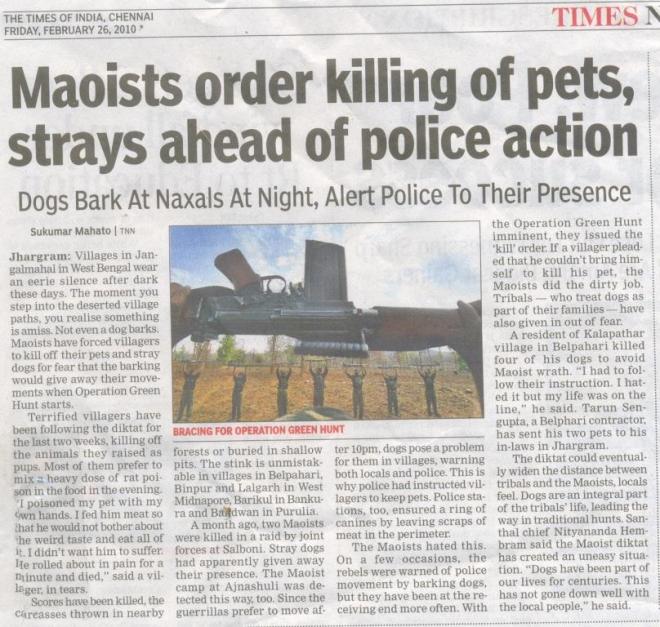
There have been cases reported of terrorists in Jammu and Kashmir resorting to killing village dogs prior to infiltering into a village to set up base. Now, the below news clipping (February 26th, 2010 dated news clipping in The Times of India, Chennai Edition) points out to what Naxals are resorting to ahead of police actions, the Maoists are killing street dogs and pets because they bark at them for obvious reasons and that ends up alerting the police of their presence.
One would think that only innocent people are being targeted by the Naxals and the Terrorists, well, that’s not true, no one knows how many dogs have lost their lives at their hands uptil now. The terrorists and naxals are known to kill street dogs before they plan an assault/attach on a human residential area. This is because street dogs being so territorial and guarding of their area will bark at the first ‘sniff’ trouble/threat that they sense from ‘outsiders’. So, please understand that the street dog you may be maligning or terming a nuisance, just because it barks, is not ‘barking without a valid reason’, he is guarding your homes, the streets in the neighbourhood from untoward people and incidents and alerting you instead. So, the next time you hear a dog barking, make an effort to understand whom he is trying to warn you against and be vigilant.
Hail the Indian street dog!
Make an effort to look at your community street dogs with a bit of respect and also look after them, for unknown to many of us, they keep many of us safe from unwanted elements, robberies and thefts.
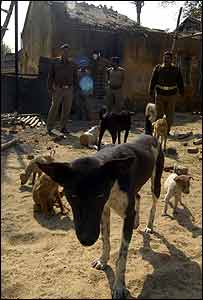
(Pics Credit and Courtesy: Prashant Ravi/BBC News)
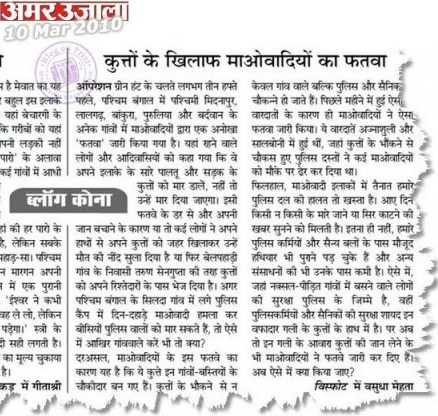
केंद्र सरकार के माओवादियों के खिलाफ छेड़े गए ‘ऑपरेशन ग्रीन हंट’ के चलते, लगभग तीन हफ्ते पहले, पश्चिम बंगाल में पश्चिमी मिदनापुर, लालगढ़, बांकुरा, पुरुलिया और बर्दवान के अनेकों गाँवों में माओवादियों द्वारा एक अनोखा ‘फतवा’ जारी किया गया. इन गाँव में रहने वाले लोगों और आदिवासियों को कहा गया कि ‘वह अपने इलाके के सारे पालतू और सड़क के कुत्तों को मार डालें नहीं तो उन्हें मार दिया जाएगा’.
इसी फतवे के डर से, और अपनी जान बचाने के कारण या तो कई लोगों ने अपने हाथों से अपने द्वारा लाड-प्यार से पाले गए अपने कुत्तों के खाने में ज़हर मिलाकर उन्हें मौत की नींद सुला दिया या फिर बेलपहाड़ी गाँव के निवासी तरुण सेनगुप्ता कि तरह अपने कुत्तों को अपने रिश्तेदारों के पास दूसरे गाँव में भेज दिया. एक तरफ अगर पश्चिम बंगाल के सिलदा गाँव में लगे पुलिस कैंप में दिन-दहाड़े माओवादी हमला कर बीसियों पुलिस वालों को मार-गिरा सकते हैं, तो ऐसे में आखिर गाँव वाले करें भी तो क्या- अपनी जान बचाएं या अपने कुत्तों की?
माओवादी आन्दोलन का जन्म 1967 में पश्चिम बंगाल के ही नक्सलबाड़ी गाँव से शुरू हुआ था जिसने आज इतना आतंकी रूप ले लिया है. अब सरकार और माओवादियों के बीच में बैर क्यों है, यह तो हममें से कई लोग जानते हैं, पर आखिर पालतू एवं गली के कुत्तों से इन नक्सलियों का क्या बैर है? इसका कारण है सिर्फ एक, अपने इलाके में बसने वाले इंसानों के द्वारा डाले गए भोजन से पलने वाले यह कुत्ते इन गाँव-बस्तियों के गैर-नियुक्त चौकीदार बन गएँ हैं, जो बड़ी वफादारी से अपने इलाके कि बाहरी, असामाजिक तत्वों से सुरक्षा भी करते हैं और इन्हें अपनी बस्तियों के आस-पास होता महसूस कर भौंक उठते हैं. कुत्तों की इसी भौंक से ना केवल गाँव वाले बल्कि इन माओवादियों के खिलाफ जुटी पुलिस और सैन्य बालों के कर्मचारी भी चौकन्ने हो जाते हैं. पिछले महीने में पश्चिम बंगाल में ही हुई ऐसी दो वारदातों के घटते शायद माओवादियों ने ऐसा फतवा जारी किया, क्योंकि अब इन कुत्तों की मौजूदगी इनके लिए घातक साबित हो रही थी. यह दो वारदातें अज्नाशुली और सालबोनी जिलों में हुईं थी, जिसमे कुत्तों के भौंकने से चौकस हुए पुलिस दस्तों ने कई माओवादियों को ढेर कर दिया था.
यह वारदातें अनोखी नहीं हैं. अनेकों बार इंसानों के सबसे वफादार दोस्त माने जाने वाले इन ‘गली के कुत्तों’ ने लोगों को चोर, लुटेरे, आतंकियों से चौकन्ना करने में मदद की है. इसका एक ताज़ा उदाहरण आगरा शहर से भी है. जनवरी महीने में ईदगाह और मोहनपुरा इलाके में दो दिन में 25 से अधिक कुत्ते मारे गए, जांच-पड़ताल करने से सामने आया कि शायद इन कुत्तों को चोरो के एक गुट ने ज़हर देकर मार डाला है, क्योंकि इनके रात को भौंकने कि वजह से वह चोरी नहीं कर पा रहे थे. इस इलाके के निवासियों कि बात माने तो इन कुत्तों के मरने के उपरान्त इस इलाके में चोरी की ढेरों घटनाएं हो चुकी हैं. इन से पहले भी ऐसे कई किस्से सुनने में आयें हैं जब पंजाब और जम्मू-कश्मीर में भी सीमा-पार से घुसने वाले घुसपैठिये और आतंकियों ने अपने डेरे डालने से पहले गाँव के कुत्तों का खात्मा किया है, ताकि वह सेना के जवानों को अपनी भौंक से सचेत ना कर दें…अशांत इलाकों में जमे भारतीय सेना के अनेकों दस्तें अपने कैंप के आस-पास बसे कुत्तों को खाना डालते हैं, और इनसे दोस्ती करते हैं ताकि किसी भी खतरे या हमलावर की मौजूदगी का आभास होते ही यह कुत्ते भौंक कर उन्हें होशियार कर सकें.
2003 में बिहार के जेहान्नाबाद शहर से 40 km दूर स्तिथ परैया गाँव की पुलिस चौकी पर हुए माओवादी हमले में 3 पुलिसकर्मी मारे गए थे. इसके बाद अपनी सुरक्षा के संसाधनों के आभाव से झूझ रही परैया पुलिस ने दस्त लगाते वक़्त गली के कुत्तों का सहारा लेना शुरू किया. सुनने में यह आया था कि इस छोटे से पुलिस चौकी के कर्मचारियों ने अपनी तन्ख्वायों में से पैसे बचा चौकी के पास रह रहे गली के कुत्तों को रोज़ ड़ाल-चावल और रोटी डालते हैं. गौर फरमाने कि एक बात यह भी है कि आज भी हमारे देश में हज़ारों गाँव में बिजली नहीं पहुंची और नक्सल-पीड़ित इन जंगल वाले इलाकों में जो बिजली पहुँचती है वह भी ना के बराबर है. ऐसे में इन पुलिस चौकियों पर तो रात को बिजली होती ही नहीं है, और इसी कमी का फायदा माओवादी संघटन रात को उठाते हैं और अंधरा होने पर वह इन पुलिस चौकियों पर निशाना साधते हैं. तभी रात को चुस्त-दरुस्त रहने वाले इन गली के कुत्तों की भौंकने की आवाज़ सुनते ही, यह पुलिस कर्मी होशियार हो जाते हैं और अपनी टोर्च जला लेते हैं. एस करके उन्हें अपने आपको माओवादियों से बचाने का मौका पा लेते हैं.
गृह मंत्रालय और Bureau of Police Research and Development ने भी 2003 में झारखण्ड के नक्सल-पीड़ित इलाकों में स्थित बैंक और डाकघरों को लाइसेंसधारी गार्ड और कुत्तों को रखने कि सलाह दी थी. विलायती कुत्तों के महंगे होने के कारण इन्हें रखना और ट्रेन करना हर किसी के बस की बात नहीं है, इसलिए यहाँ के कई बैंकों और डाकघरों ने पड़ोस में रह रहे गली के कुत्तों को खाना डालके इनसे दोस्ती कर इन्हें ही अपना रक्षक बनाया और अब यही दिन-रात चौकीदारों के साथ मिलकर इन इमारतों की सुरक्षा करते हैं. मई 2005 में आंध्र प्रदेश में हैदराबाद से 340 किलोमीटर दक्षिण की और स्थित ‘दुर्गी गाँव’ में गली के कुत्तों के भौंकने से सतर्क हुए पुलिसकर्मियों ने पुलिस कैंप को एक बड़े माओवादी हमले से को बचा लिया था. इस घटना के बाद तब आंध्र प्रदेश पुलिस के डी.आई.जी स्वर्णजीत सेन ने नक्सल-पीड़ित इलाके में स्तिथ पुलिस चौकियों के पुलिस कर्मियों को आदेश दिए थे कि वह अपनी चौकियों के आस-पास रह रहे कुत्तों को रोज़ खाना ड़ाल उनसे दोस्ती बढाएं, ताकि पुलिस चौकियों को माओवादियों के हमले से बचाया जा सके. जैसा कि अक्सर देखा गया है, पुलिस चौकियां और सैन्य बलों के कैंप ही माओवादियों के धावा बोलने के मन-पसंद निशाने हैं.
छत्तीसगढ़ प्रांत में तो इन गली के कुत्तों ने इतिहास ही रच डाला और अप्रैल 2009 में बस्तर ज़िले में आम-चुनावों के दौरान तेजा, करीना, सैली और लिली नामक चार गली के कुत्तों ने पुलिस वालों के साथ इस घने जंगल वाले इलाके में तब मोर्चा संभाला जब माओवादियों ने इस इलाके में ढेरों भूमिगत विस्फोटक मैईन (landmine) बिछा दी थीं और गांववालों को आम-चुनावों का बहिष्कार करने को कहाँ था…. एक सच्च यह भी है कि नक्साली इलाकों में 95 प्रतिशत सुरक्षाकर्मियों कि मौत IED फटने से होती हैं. इन चारों कुत्तों कि इस अनोखे मुकाम तक पहुँचने की कहानी कुछ ऐसे है -माओवादी गतिविधियों से प्रताड़ित इस राज्य में 2005 में छत्तीसगढ़ सरकार द्वारा CTJWC (Counter Terrorism and Jungle Warfare College) की कांकेर ज़िले में स्थापना की गई. इसकी अध्यक्षता संभालने के लिए छत्तीसगढ़ सरकार ने भारतीय सेना से सेवा निवृत हुए ब्रिगेडियर बी.के. पोंवर को बुलाया, जो इससे पहले मिज़ोरम में सेना के विख्यात Counter insurgency and Jungle Warfare School की अध्यक्षता संभाल रहे थे. जुलाई 2007 में CTJWC के कैम्पस में घूमते हुए उनकी नज़र चार हृष्ट-पुष्ट गली के कुत्ते के पिल्लों पर पढ़ी. उन्होंने इन पिल्लों को उठाया और इन्हें CTJWC में Sniffer Dog की ट्रेनिंग देने वाले दस ट्रेनरों के हवाले कर दिया. आम तौर पर Sniffer Dogs की भूमिका के लिए विलायती pedigreed कुत्तों को ट्रेन किया जाता है (जैसे कि- लाब्राडोर, अल्सेशियन, जर्मन शेफर्ड, कोकर स्पेनियल और डोबेर्मन). पर इस बार पोंवर साब ने गली के कुत्तों को 9 महीने के कड़े ‘कुत्तों के IED (Improvised Explosive Device) Detection Training कुरसे’ में इनका दाखिला करा दिया. 9 महीनों की कड़ी ट्रेनिंग के बाद, यानी 1 अप्रैल 2008 को, यह चार पिल्ले – करीना, लिली, तेजा और सैली CTJWC के इस ट्रेनिंग कार्यक्रम से स्नातक होकर निकले. इस ट्रेनिंग में उन्हें ज़मीन में 6-12 इंच नीचे दबी IED को सूंघ के पहचानने की ट्रेनिंग दी गयी थी. इन चारों की काबलियत से प्रसन्नचित होकर दो और गली के कुत्तों- रामबो और मिल्ली को ट्रेनिंग course में शामिल कर लिया था…और यह तो बस शुरुआत है.
पिछले साल बस्तर ज़िले में चुनाव वाले दिन CTJWC के अध्यक्ष बी.के. पवार ने पत्रकारों के साथ हुई एक बातचीत में इन गली के कुत्तों की माओवादियों से निपटने में सक्षम होने की खूबियों पर प्रकाश डाला. उन्होंने बताया कि गली के कुत्तों को ऐसे कार्यों में ट्रेन करने के अनेक फायदे है, पहला यह कि जहाँ कुत्तों की pedigreed प्रजातियों के पिल्ले बाज़ार में 85,000-1,25000 रूपये प्रति मिलते हैं, जबकि गली के कुत्ते मुफ्त हैं! इसके इलावा यह गली के कुत्ते होशियार हैं, समझदार हैं, चुस्त-दरुस्त हैं, रात को भी ऑपरेशन के दौरान इनकी आँख नहीं लगती और यह सतर्क रहते हैं..साथ ही इन्हें इन इलाकों के अधिक तापमान में रहने कि आदत है, घने-जंगली और मुश्किल इलाकों में यह स्फूर्ति से घूम-चल पाते हैं..यहाँ तक कि कभी कभी एक दन में 25 किलोमीटर तक चलने में भी यह गली के कुत्ते सक्षम पाए गए हैं और नक्सल पीड़ित जंगली इलाकों में घूमते वक़्त ना तो यह गर्मी से परेशान होते हैं और ना ही बीमार होकर वेट डॉक्टर का खर्चा बढ़ाते हैं..अक्सर गर्मी के कारण अल्सेशियन और लाब्राडोर कुत्ते (sniffer dogs) जंगल में बीमार पड़ गए हैं, जिससे पुलिसकर्मियों को कभी-कभी परेशानी हुई है..क्योंकि कई बार नक्सालियों के खिलाफ कार्यवाही कई दिनों तक जंगल में चलती है और बीमार कुत्तों को लेकर घूमने में परेशानी भी हो जाती है…ऐसे में पोंवर साहब कहते हैं, “आखिरकार यह गली के कुत्ते लोकल हैं, अपने इलाके से प्रेम करते हैं और इसकी सुरक्षा के प्रति वफादार हैं, यह हमारी नाक नहीं कटवा सकते. साथ ही हमें यह समझना पड़ेगा कि अशांत, आतंक और नक्सल पीड़ित इलाकों में तो वृद्धि हो रही है और sniffer dogs की मांग और आपूर्ति में भारी अंतर है, इसलिए ऐसे में गली के कुत्तों के समझदार होने का, इनके असामाजिक तत्वों से निपटने में निपुण होने के कारण हमारा इन कुत्तों का सुरक्षा सम्बन्धी कार्यवाहियों में इस्तेमाल करना एक समझदारी पूर्ण निर्णय होगा”.
माओवादी इलाकों में तैनात हमारे पुलिस दल की हालत तो फिलहाल खस्ता है, आये दिन किसी न किसी के मारे जाने या सर काटने की खबर सुनने को मिलती है…हमारे पुलिस कर्मियों और सैन्य बालों के हत्यार पुराने हैं और अन्य संसाधनों की भी कमी है…ऐसे में जहाँ नक्सल-पीड़ित गाँव में बसने वाले लोगों के सुरक्षा पुलिस के हाथ में है, वहां ही इन पुलिसकर्मियों और सैनिकों की सुरक्षा शायद इन वफादार गली के कुत्तों के हाथ में है…पर अब तो इन गली के कुत्तों की जान लेने के भी माओवादियों ने फतवे जारी कर दिए हैं, अब ऐसे में क्या किया जाए?
This article written by respected senior Journalist Hiranmay Karlekar* was first published in the *OPED* Page | Thursday, March 18, 2010 | The Pioneer
Killing of stray dogs reflects the ultimate form of sadism
What is there in common among some Maoists committed to a violent overthrow of the existing state, some bureaucrats sworn to uphold the Constitution of India and the rule of law, and some presidents of Residents’ Welfare Organisations? The answer is simple: The killing of stray dogs — or the ordering of their killing — which is prohibited by law. The Animal Birth
Control (Dog) Rules 2001, promulgated under the Prevention of Cruelty to Animals Act of 1960, only allow for the removal of stray dogs for neutering and vaccination against rabies and their subsequent return to where they had been taken from. The Guidelines for Dog Population Management, issued in 1990 by the World Health Organisation and the World Society for the Protection of Animals, and several other WHO reports, make it clear that this is the only scientific way of reducing the population of stray dogs.
The logic of the animal birth control programme is that dogs, being territorial, prevent other dogs from entering their domains. Neutered and vaccinated stray dogs prevent un-neutered and un-vaccinated dogs from other areas from entering their territories. Hence, having neutered dogs in one area, those administering the ABC programme can move into another and repeat the performance. In this manner, an entire city, State or country is covered and the number of stray dogs declines steeply as each of them lives out its biological span of life. Then why the killing?
In the case of Maoists, it is a part of their war against the state. The barking of stray and pet dogs warns police pickets and villagers of their presence; surprise attacks are foiled and arrests facilitated. They are not alone in this. Terrorists in Punjab and those sent across the Line of Control in Jammu & Kashmir by Pakistani terrorist outfits like Lashkar-e-Tayyeba, Hizbul Mujahideen and Jaish-e-Mohammad, had asked locals to kill all dogs in their respective villages. Significantly, Mr Swaranjit Sen, when he was the Director-General of Police in Andhra Pradesh, had asked all police stations to adopt local stray dogs who would alert them to the approach of Maoists at night.
To Maoists, the killing of stray and pet dogs is a part of the collateral damages of war, which affects innocent people as well. There is a measure of truth in this. According to a report, a herd of 80 elephants is in dire straits in south Bengal as their return to their habitat is prevented by the presence of Maoists and security forces in the forests through which they have to pass. In *All Quiet on the Western Front,* Erich Maria Remarque gives a heart-rending account of the agony of horses wounded in World War First. The issue with Maoists is the deeper one of violence as an instrument of capturing power, which is unjustified in a country where parliamentary institutions for peaceful change in Governments exist and where even revolutionary changes in socio-economic relations can be wrought through constitutional amendments. As the results of the French, the Bolshevik and Chinese revolutions indicate, revolutions devour their children and seldom achieve their goals.
The problem with civil servants, particularly heads of municipalities who are aware of the law but still order the killing of stray do, is different. They display an utter contempt for the Constitution and an arrogance whose effects are felt in arbitrary and savage actions in other fields as well. If this makes them unsuited to holding high offices involving the exercise of a significant measure of power, their actions and the demand for killing of stray dogs by heads of RWA, also displays a genocidal streak.
In his seminal work, “Fear of Freedom”, Erich Fromm shows how sadism reflects a desire to overcome one’s own feeling of insecurity through domination over others. The most complete form of domination is over life itself which is realized through an act of killing. Genocide is the most grotesque expression of sadism.
Since a call for the mass killing of a religious community or an ethnic group will immediately fetch mass opprobrium, a substitute is sought in the killing — or ordering the killing — of stray dogs. Hence we return to the question: Can people calling for it be entrusted with offices of power?
*Mr. Hiranmay Karlekar is Consultant Editor, The Pioneer and Author of the book titled, ‘Savage Humans and Stray Dogs: A Study in Aggression’
नौकरशाह जब रिटायर होता है तो अपने अनुभव को आधार बनाकर मुख्य रूप से तीन बातों पर अपना ध्यान केन्द्रित करता है. पहला, किसी गैर सरकारी एजंसी में अपनी नियुक्ति को सबसे अधिक प्राथमिकता देता है. दूसरा, अखबारों में लेख लिखता है और उन सिद्धांतों की व्याख्या करना शुरू करते हैं जिनके बारे में वे खुद ठीक से कुछ नहीं जानते और तीसरा, जहां वे रहते हैं उस कालोनी या घेरेबन्द इलाके का मुखिया होने की कोशिश करते हैं. इन घेरेबंद कालोनियों की रेसिडेन्ट वेलफेयर एसोसिएशनों के मुखिया बनते ही उनका पहला और पसंदीदा कार्य होता है कालोनियों में विचरण करनेवाले गली के कुत्तों के खिलाफ अभियान.
दिल्ली में ऐसा ही होता है. नौकरशाहों के स्वर्ग इस शहर में हाल में ही दिल्ली में ऐसे ही लोगों के एक समूह ने उनके ‘पागल, पीड़ित पड़ोसियों’ से उन्हें बचाने के लिए उच्च न्यायालय में एक अर्जी पेश की है। इन नौकरशाहों के असभ्य जाहिल और गरीब पड़ोसी गली के आवारा कुत्तों को रोटी खिलाते हैं और उससे भी बड़ा अपराध ये कि उन्हें प्यार भी करते हैं. कालोनी निवासियों के हर घर में भले ही एक डॉगी डींगे भर रहा हो लेकिन इन निवासियों को यह मंजूर नहीं है कि सड़क पर रहनेवाले लोग सड़क पर विचरनेवाले कुत्तों को प्यार करें या उनका संरक्षण करें. इन सब लोगों के लिए अब यही एक आखिरी सहारा है अपने लिए न्याय और मन की शान्ति पाने का क्योंकि बहुत समय तक इन दिल्लीवासियों को अपने पड़ोसियों का उपहास, धमकियाँ, गालियाँ और ब्लैकमेलिंग का िशकार बनना पड़ा है क्योंकि वह अपनी गली के कुत्तो की परवाह करने का रोज `अपराध´ करते हैं। सवाल यह है कि क्या अपनी गली के कुत्तो को पुचकारना या उन्हें खाना खिलाना एक `गलती´ है?
कोर्ट का निर्णय एक तरफ और सरकार द्वारा ऐसे आवारा कुत्तों की नसबंदी का प्रयास भी एक तरफ लेकिन हमारी सड़कों पर घूमने वाले आवारा कुत्तों के बारे में हमें भी ठीक से जानने की जरूरत है। देश के कई शहरों में सरकारी एजेिन्सयाँ गैर सरकारी संघटनों के साथ मिलकर पशु जन्म नियंत्रण और टीकाकरण कार्यक्रम संचालित करती हैं। लेकिन हम भूल जाते हैं कि भारत के सड़क पर रहने वाल आवारा कुत्ते बेहद ही बुद्धिमान प्रजाति है जो दुनिया की सबसे पुरानी कुत्तों की नस्लों में से एक है। यह प्रजाति एिशया और अफ्रीका में स्थापित पहली मनुश्य बस्तियों से इन्सानों के साथ खुशी-खुशी मौजूद रही हैं वास्तव मेें शहरी बस्तियों में इन कुत्तों का प्राथमिक उद्देश्य मनुश्य की रक्षा करना और बची खुची खाद्य वस्तुओं का सेवन करके सफाई रखने में है। यह ही वजह है कि आज भी गरीबों की बस्तियों में कुत्तों को ज्यादातर स्थानीय निवासी खाना खिलाते हैं।
पशु नसबंदी टीकाकरण और उन्हें पुन: अपने मूल क्षेत्र में छोड़ने का कार्यक्रम वैज्ञानिकों द्वारा इसका औचित्य सिद्ध करने में विश्व स्वास्थ्य संगठन को कई साल लगे हैं। दुनिया भर की न्यायपालिकाओं, नागरिक संगठनों ने इस कार्यक्रम को अपनाया है और इसकी सफल्ता की कहानियाँ आज की तारीख में दुनिया के कई शहरों से सुनने को मिलती है, जिनकी शुरूआत अमरीका से हुई थी। कुत्तों की नसबंदी करने की अवधारणा अमेरिका की सैन मात्तियो नामक काउन्टी के नागरिक अधिकारियों के दिमाग में तब आई जब उन्होंने देखा कि कुत्तों को मारने के उनका कार्यक्रम से उनकी आबादी में कोई गिरावट नहीं हो रही थी। इसके बाद सैन मात्तियो काउन्टी ने कुत्तों का नसबंदीकरण कराने के प्रस्ताव को स्वीकृति दी जो कि एक महान सफलता साबित हुई। आज अमेरिका और कनाड़ा के विभिन्न भागों में इसका सफलतापूर्वक संचालन किया जा रहा है।
नसबंदीकृत कुत्तों को उनके मूल निवास क्षेत्र पर बहाल करने के पीछे वैज्ञानिक सोच हैं कुत्ते प्रादेिशक जानवर हैं। वे भोजन की उपलब्धि के आधार पर अपने प्रदेश को अंकित करते है। और बाहरी कुत्तों को अपने क्षेत्र में नहीं आने दते। जब कुत्तों को अपने क्षेत्र से हटाया जाता है तो बाहर से दूसरे कुत्ते इस खाली क्षेत्र पर कब्जा कर लेंगे क्योंकि वहाँ भोजन स्त्रोत अभी भी उपलब्ध हैं जब कोई बाहर का कुत्ता किसी कुत्ते के क्षेत्र में घुसता है तो उनके बीच में लड़ाइयाँ बढ़ती है और नसबन्धिकृत ना होने के कारण यह बच्चे पैदा करते रहते हैं और उस क्षेत्र में कुत्तों की संख्या बढ़ती रहती है। इन बाहरी कुत्तों के नसबन्धिकृत और रेबीज के विरूद्ध टीकाकरण ना होने का कारण उस क्षेत्र के निवासियों के लिए खतरा बना रहता है। एक नसबंधीकृत कुत्ते को रेबीज के विरूद्ध टीकाकरण भी किया जाता है, वह प्रजनंन नहीं करते, शान्त रहते हैं, अपने क्षेत्र को सुरक्षित करते है औरी ना ही आपस में लड़ते-भौंकते है। एक नसबंधीकृत कुत्तों को उसके एक आधे-कटे कान से पहचाना जा सकता है। पशु जन्म नियंत्रण दिल्ली में पिछले कई वर्षों से संचालित है – इन वर्षों में रेबीज के किस्सों में भी कमी आई है जो कि सरकारी और गैर-सरकारी संगंठनों की एक उल्लेखनीय उपलब्धि है।
विश्व स्वास्थ्य संगठन और भारतीय पशु कल्याण बोर्ड द्वारा किए गए अध्ययनों से पता चलता है कि कुत्तों की जनसंख्या पर नियंत्रण पाने के लिए जो कार्यक्रम विकसित देशों में काम करते है वह विकासशील देशों में असफल रहे हैं क्योंकि वहाँ पर शहरी स्थितियाँ हमारे यहाँ से बहुत अलग है। भारत के शहरी पर्यावरण में ऐसी दो विशेषताएँ है जो आवारा जानवरों की आबादी में वृद्धि को प्रोत्साहित करती हैं :- मलिन बिस्त्याँ और उजागर कचरा, जो कि विकसित देशों में मौजूद नहीं है। विकसित देशों में आवारा कुत्तों का सड़क पर जीवित रहना असंभव है क्योंकि उन्हें सड़कों पर कुछ खाने को नहीं मिलता, इसलिए उन्हें पकड़ कर आश्रयघरों में ले जाया जाता है जहाँ उनकी नसबंदी करके उनका पुनर्वास करवाने का प्रयत्न किया जाता है।
कुत्तों की जनसंख्या को नियंत्रित रखने के लिए उन्हें `पकड़ने और मारने´ का कार्यक्रम अंग्रेजों ने 19वीं सदी में शुरु किया था। आजादी पाने के बाद भी भारत की नगरपालिकाओं ने इस कार्यक्रम को जारी रखा। दिल्ली नगर निगम द्वारा किए गये एक अध्ययन के अनुसार 1980-1990 के दौरान 8 लाख कुत्तों का कत्लेआम करने के बावजूद दिल्ली में कुत्तों की संख्या 1.5 लाख ही रही और उसमें तिनके भर की कमी नहीं हुई। 1993 में नगर निगम ने स्वीकार किया कि कुत्तों को `पकड़ने और मारने´ की यह योजना पूरी तरह से रेबीज और कुत्तों की जनसंख्या को नियंत्रण करने में `असफल´ नही है। इसलिए सन् 1994 में न्यायपालिका ने आदेश दिया कि कुत्तों की हत्या करनी बन्द करी जाए और उनकी `नसबंदी और टीकाकरण´ कार्यक्रम शुरू किया जाए जिससे पशु-जन्म नियंत्रण का कार्यक्रम भी कहा जाता है। मुंबई, कोलकता, चेन्नई, जयपुर और हैदराबाद की उच्च न्यायालयों के भी ऐसे आदेश जारी करने के बाद इन शहरों में भी `पशु-जन्म नियंत्रण के लिए कुत्तों की नसबन्दीकरण और टीकाकरण कार्यक्रम शुरू किए गए। इस कार्यक्रम के तुरन्त अच्छे नतीजे देखने के बाद भारत सरकार ने 2001 में देश भर में इस कार्यक्रम को शुरू करने के आदेश दिए।
एक आश्चर्यजनक सत्य यह है कि जिस बात के लिए गली के कुत्ते बदनाम है वह हरकत वे बहुत कम करते हैं. कुत्तों के काटने की जो घटनाएँ होती हैं इनमें से बहुत कम आवारा कुत्तों की वजह से होती हैं। अध्ययनों से पता चला है कि 90 प्रतिशत से भी अधिक कुत्तों के काटने की घटनाएँ पालतू कुत्तों की वजह से होती है जो कि अपने घर और क्षेत्र की सुरक्षा करते हुए आक्रमक हो जाते हैं। हर साल पालतु कुत्तों की संख्या में वृद्धि हाती है और साथ ही कुत्तों के काट-खाने की घटनाओं में भी। सिर्फ 5 प्रतिशत घटनाएँ आवारा कुत्तों की वजह से होती है जो या तो कुत्तों को कॉलोनी निवासियों द्वारा पीटे जाने या मादा कुत्तिया द्वारा उसके बच्चे को नुकसान पहुंचाए जाने के कारण इंसान पर हमला कर बैठती हैं।
गली के कुत्ते प्रकृति में शहर के कूड़े-करकट को साफ रखने का एक माध्यम है। वह शहर में चूहों और अन्य कृतंक कीटों की संख्या को नियंत्रण में रखते हैं, जिनको नियंत्रण में रखना मानव के लिए मुिश्कल है। यदि इन कुत्तों को भारत के शहरों से पूरी तरह हटा दिया जाए तो नाकि कूड़ा भारी मात्रा में जमा हो जाएगा बल्कि चूहों की संख्या भी हाथ से निकल जाएगी। आज, जब भारत के कई शहर डेंगू और चिकुनगुन्या जैसी बीमारियों से अपनी मैली नागरिक स्थितियों के कारण जूझ रहे हैं, उस समय यह गली के कुत्ते ही है जो शहरों में चूहों की आबादी को जाँच में रखते है – चूहे `ब्युबोनिक प्लेग´ जैसी घातक बीमारी के वाहक हैं। चूहों की एक जोड़ी पैदा होने के छ: सप्ताह के भीतर प्रजनन के लिए तैयार हो जाती है। इस दर पर चूहो की एक जोड़ी प्रत्येक वर्ष के अंत तक 35000 चूहों में बदल जाती है। आज की तारीख तक किसी भी नगर निगम ने चूहों का विनाश करने के लिए किसी भी योजना में एक पैसा भी आवंटित नहीं किया है। 1980 में गुजरात के सूरत शहर का भयानक प्लेग बीमारी से संक्रमित होने का एक कारण यह भी था कि स्थानीय नगरपालिका ने सूरत शहर की सड़कों पर रहने वाले कुत्तों को बेरहमी से मार डाला था।
भारत जैसे देश में सारे सड़क के कुत्तों को एकाग्रता िशविरों या डॉग-पाउण्ड में ठूस देना व्यावहारिक रूप से असंभव है। ऐसे कार्य को करने के लिए जगह, समय और संसाधन सरकार कहाँ से पैदा करेगी। जब झुग्गी बस्तियों में रहने वालों या आवासीय क्षेत्रों से वाणििज्यक प्रतिष्ठनों को बाहर निकालने के लिए तो कोई जगह है नहीं। इसलिए समझदारी तो बस इसमें है कि सड़क के कुत्तों को उनकी जगह पर रहने दिया जाए। असल में हर जिम्मेदार और मानवीय निवासी कल्याण संघ को इस कार्यक्रम का भागीदार बनना चाहिए और अपने शहर में काम करने वाली नगर पालिकाओें द्वारा संचालित पशु-जन्म नियन्त्रण कार्यक्रम के अन्तर्गत अपने क्षेत्र के आवारा कुत्तों का नसबंदीकरण और नियमित टीकाकरण कराना चाहिए। पशुओं के मामले में स्वामित्व का सवाल तो उठता ही नहीं है, जब हम आज आदिवासियों को उस वन भूमि पर रहने का अधिकार देने वाले बिल को पारित करने की बात करते है जहाँ यह आदिवासी सदियों से जी रहे है तो पशुओें के मामले में उनका जन्मसिद्ध अधिकार उसी जगह पर रहने का है जहाँ वो पैदा हुए हैं।
कुत्तों की हत्या करके रेबीज पर नियंत्रण पाने के कार्यक्रम कई विकासशील देशों में जैसे कि – पाकिस्तन, इरान, इराक, साउदी अरब, उत्तर कोरिया, अफगानिस्तान, जार्डन, सीरिया, यमन, बांगलादेश, नेपाल, यूक्रेन, उज्बेकिस्तान – हर जगह ही `नाकाम´ रहे हैं। कुत्ता आदमी का सबसे ईमानदार और वफादार दोस्त है और हम में से कई लोगों को जरा सा भी नुकसान नहीं होगा अगर हम अपने गली में रह रहे एक कुत्ते को दिन में एक बार अगर कुछ खिला या पिला दिया करें। अगर हम यह करें तो मैं दावे के साथ यह कह सकती हूँ कि आपको अपने घर के दरवाजे पर हमेशा अपनी पूंछ फड़फड़ाता एक साथी नज़र आएगा जो रोज शाम आपके थकान भरे दिन के बाद आपका दिल खोलकर स्वागत करेगा। इस बेहद स्वार्थी दुनिया में बिना शर्त प्यार और सम्मान की लालसा हम सब करते है और शायद इस लालसा की पूर्ति करने के लिए आपका बेहतरीन साथी आपकी गली का कुत्ता है।
{The above Video was made for a group by the name of ‘People for Animals’, we are sharing and embedding it here on Jaagruti because it beautifully communicates the story of the Indian Street Dog}
Bureaucrats who retire do one of three things: they lobby to be appointed to some government body so that they can retain their houses; and more often than not they stand for Residents Welfare Associations so that they can bully someone or they write article for the newspapers and the less they know , the more they expound their theories…and more often than not for most RWAs across Delhi and NCR, their favourite subject is ‘Dogs in their colonies’…this article comes at a time when a group of people in Delhi have moved to the High Court with a plea to ’save them from their rabid neighbours’. This is perhaps their last resort to seek justice and peace of mind, because for far too long, many of these Delhiites had been ridiculed and abused, threatened and blackmailed by their (‘rabid’) neighbours for a ‘crime’ of theirs; the fault being that these group of people ‘loved and cared for the street dogs, their much friendlier neighbourhood denizen’.
This article is a humble attempt to enlighten you all about our friendly neighbourhood street dog and clear the facts about the utility of the Animal Birth Control (ABC) and Vaccination Programme run by the Delhi Government (MCD and NDMC) through about 7 partner NGOs in Delhi for these canines.
India has been home to the highly intelligent Pariah dog, one of the world’s oldest canine breeds, existing in Asia and Africa since human beings first started living in settlements. They co-exist happily with humans, in fact their primary aim in urban settlements is to protect humans and to act as scavengers. It is not for no reason that each dog is fed by local residents and occupies pride of place in poor settlements.
The rationale of the animal sterilization, vaccination and re-release to its original area is a scientifically worked out programme which took years to evolve by WHO, civic authorities the judiciary, backed by success stories round the world starting from America. The concept of sterilization of dogs itself came from San Mateo in the United States, when civic authorities realized that killing dogs had not lead to any decrease in the dog-population. The County of San Mateo passed the resolution to sterilize and this was a great success. This programme is being followed successfully in various parts of America and Canada and many other developed as well as developing nations.
There is scientific thought behind restoring a sterilized dog to his original habitat. Dogs are territorial animals. They mark out their territories based on the food available and they do not let outsiders come in. When these local dogs are removed from their territory, other dogs move in to occupy them. These may not be sterilized so the problem continues for that locality. Dog fights increase as any new dog entering a territory is attacked by the dogs already in that area and non-sterilized dogs continue to mate and produce litters. Rabies continues to spread as none of the dogs in that area are vaccinated against it. The new dogs are hostile to the residents so problems of safety continue. A sterilized and vaccinated dog doesn’t breed, they guard their territory from intruders and new dogs, they become docile and don’t fight with other dogs during the mating season. You can identify a sterilized and a vaccinated dog by a triangular notch on one of its ears.
The ABC programme has been in place for many years now – and noticeably the rabies incidences have reduced, which is a remarkable achievement by the civic authorities and the NGOs.
Studies by the World Health Organization and the Animal Welfare Board of India show that dog-population control measures which work in developed countries are unsuccessful in developing countries like ours since urban conditions are very different over here. The urban environment in India has two features that encourage stray animal populations-exposed garbage and slums-neither of which exists in developed countries. Stray dogs in developed countries are unable to survive or breed on city streets since they can find nothing to eat. Hence, over there, they are captured, housed in animal shelters, neutered and re-homed.
The ‘catch and kill’ concept of controlling dog-population was started by the British in the 19th Century. It was continued on a large scale after Independence by the municipal authorities all over India with the aims of eradicating rabies and controlling street dog populations. Statistics in a study done by the MCD from 1980 to 1990 showed that even after the slaughtering of 8 lakh dogs during the 10-year period, the estimated dog population in Delhi remained 1.5 lakhs. – MCD could not reduce the population even by one. By 1993, the ‘catch and kill’ method was admitted to be a complete failure since rabies deaths had actually increased and the dog population was also perceptibly growing. Thus, in 1994, the courts ordered the dog-sterilization-cum-vaccination programme (popularly known as the “Animal Birth Control” or ABC programme) to replace the killing. Similar programmes were started in Mumbai, Kolkatta, Chennai, Jaipur, and Hyderabad after the High Courts in these cities passed similar orders. Finally, seeing the immediate success of the programme, in 2001, the Government of India has ordered this all over India with the Animal Birth Control (for Dogs) Rules being notified in 2001 under the Prevention of Cruelty to Animals Act 1960.
Dog-bites are very rarely due to stray dogs. Studies show that over 90% of the dog bites are from pet dogs that are aggressive when it comes to defending their territory or repelling intruders to their homes. Every year the numbers of pet-dogs increase and so do the bites. The 5 % of bites which are due to strays are from dogs that have been hurt by colony residents or bitches whose puppies were being attacked.
Dog is nature’s city scavenger. Its specific purpose is to keep garbage, city rats and other non-rodent pests that do not respond to human control in check. If it is removed then, apart from the piling up of huge quantities of garbage, the rat population will also go out of hand. With many cities in India suffering from Dengue and Chikugunya due to unhygienic civic conditions, it is dogs that are responsible for keeping the city’s rat population under check. Rats are the carriers of the deadly bubonic plague disease. One pair of rats is ready for breeding within six weeks of being born. Each pair turns into 35,000 rats by the end of each year. No municipal corporation has till date allocated a single-paisa for the destruction of rats. In 1980, one of the reasons why Surat in Gujarat was infected with plague was the decimation of the city’s street dogs by the local municipality.
It is practically impossible in a country like ours to dump all street dogs into concentration camps or dog pounds. Where is the space, time and resources to carry out this exercise when there is no space to shift commercial establishments out of residential areas or rehabilitate the slum dwellers?
It makes more sense to let the dog live where it belongs. In fact every responsible and humane RWA should contribute and become a partner in getting their dogs sterilized and vaccinated at any of the animal hospitals set up in Delhi for this purpose.
The question of ownership doesn’t arise in this case at all. We talk of passing bills that would give tribals the right to live on forest lands on which they have been living for ages. In case of animals, the place where they are born is the place to which they belong.
The killing method has failed to control rabies in developing countries -including Pakistan, Iran, Iraq, Saudi Arabia, Cambodia, North Korea, Afghanistan, Jordan, Syria, Yemen, Bangladesh, Nepal, Ukraine, Uzbekistan. Most of these countries have now adopted the Indian method of ABC.
Dogs are a man’s best friend…and it won’t harm many of us if we were to feed the dog in our street once a day, and we can be sure that we would have a friend by our doorstep delightful to see us every time we step out or come home after a long tiring day…and in this selfish world, it is unconditional love and respect that we all crave for and our very own street dog is perhaps our best bet!
To read this article in Hindi language, please click hereयह गली के कुत्ते.
If you have some time to spare and few thoughts to spare as well, watch the Videos below, may be you will end up changing your mind and be kind the next time you see our very own Indian Dog on the street.
{The above Video was made for a group by the name of ‘People for Animals’, we are sharing and embedding it here on Jaagruti because it beautifully communicates the story of the Indian Street Dog}









 JAAGRUTI® -
