http://www.thepetitionsite.com/1/jkmassculling/
Dr. Asgar Samoon, Divisional Commissioner, Kashmir, had issued orders in March 2011 to kill all street dogs of Kashmir.
A qualified veterinarian, he has admitted to the Animal Welfare Board of India, to requesting the ‘public’ to identify rabid dogs !
He obviously hasn’t let his veterinary knowledge come in his way. Carnage is reported to be occurring in Kashmir everywhere. Dogs are being poisoned and killed brutally in the name of rabies which is nowhere to be found or identified.
Mass graves are being dug and dogs being dumped into that. Any neighbour who has a grudge against another with a pet has now the licence to kill that pet dog.
Animal activists have demanded suspension of the Divisional Commissioner and appealed to the Veterinary Council of India to revoke his licence as he is not fit to be a vet. If you support this, please write to:
VETERINARY COUNCIL OF INDIA
A statutory body of Government of India established
under the Indian Veterinary Council Act 1984.
A-Wing, 2nd Floor, August Kranti Bhawan
Bhikaji Cama Place, New Delhi – 110066
Phone: 011-26184149, 26184354 Fax: 011-26182434
Email vciinfo@vhub.nic.in
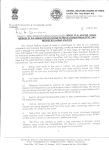
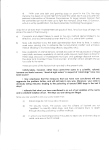
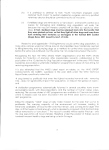
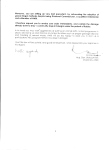
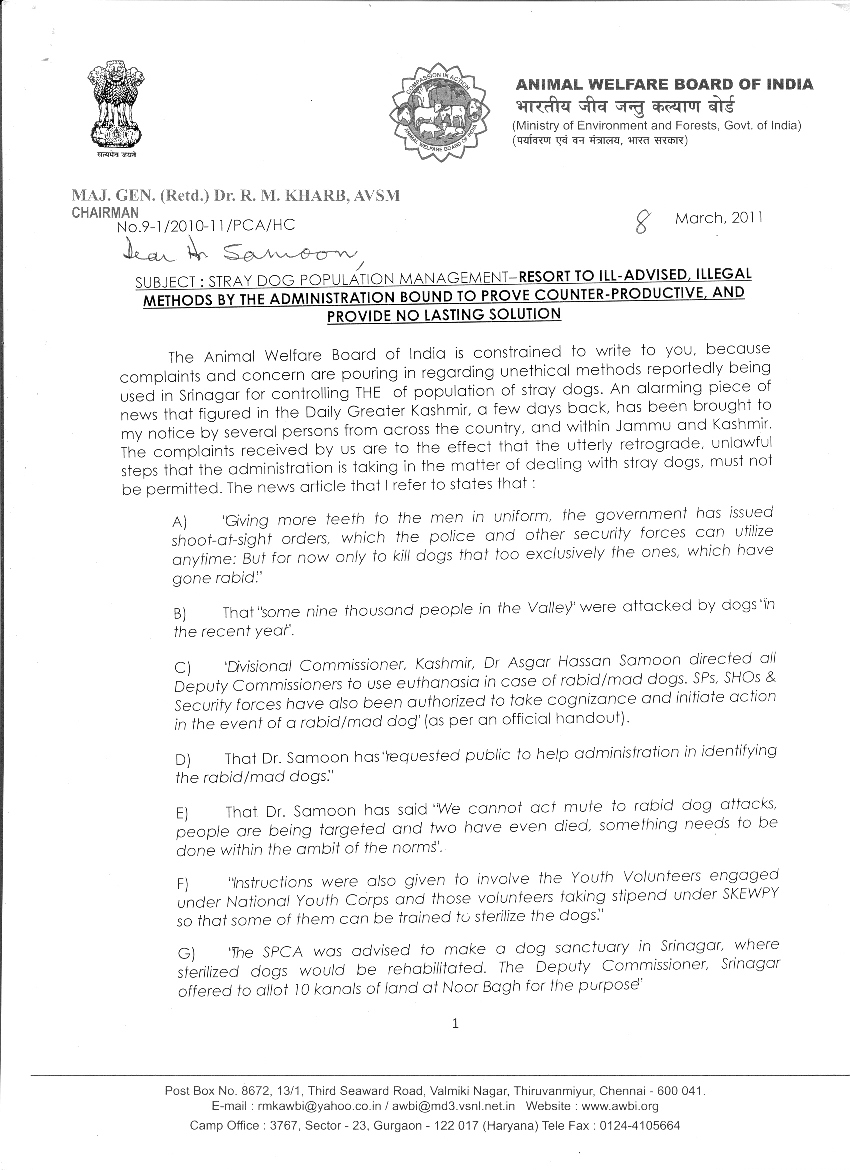
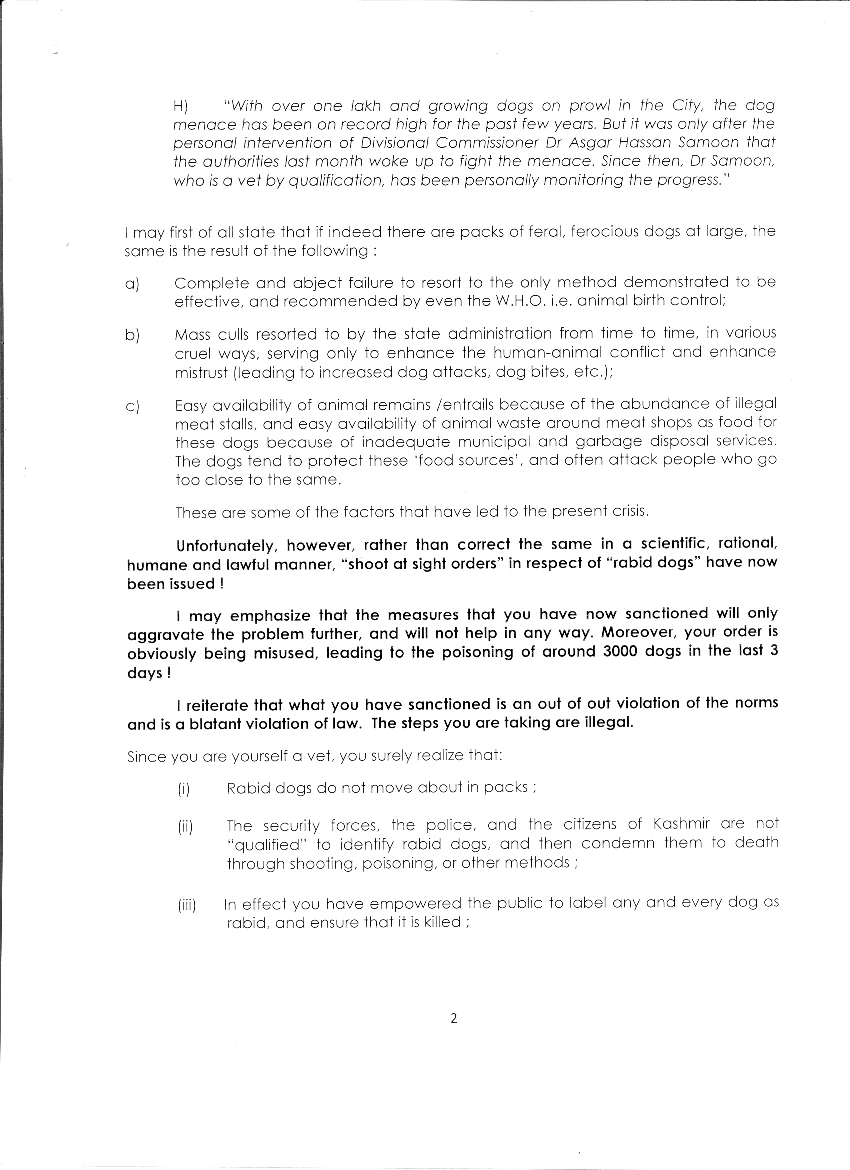
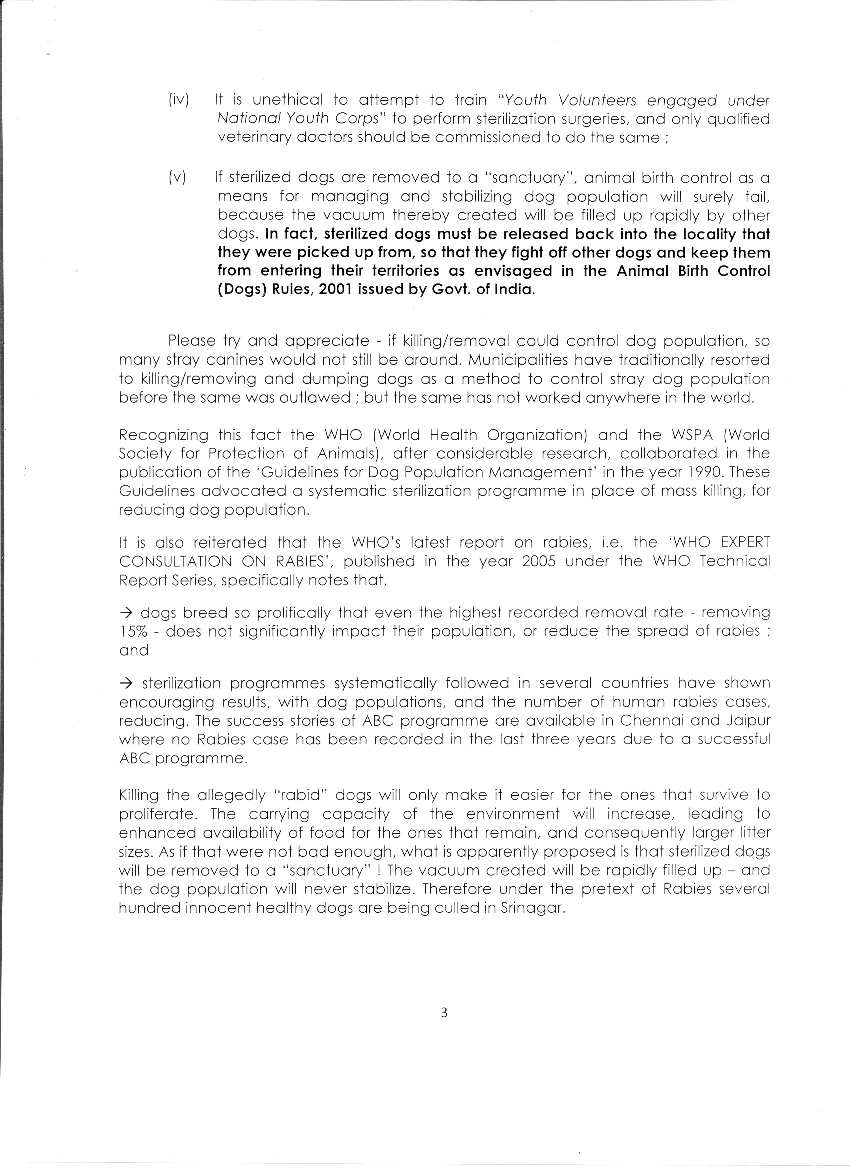
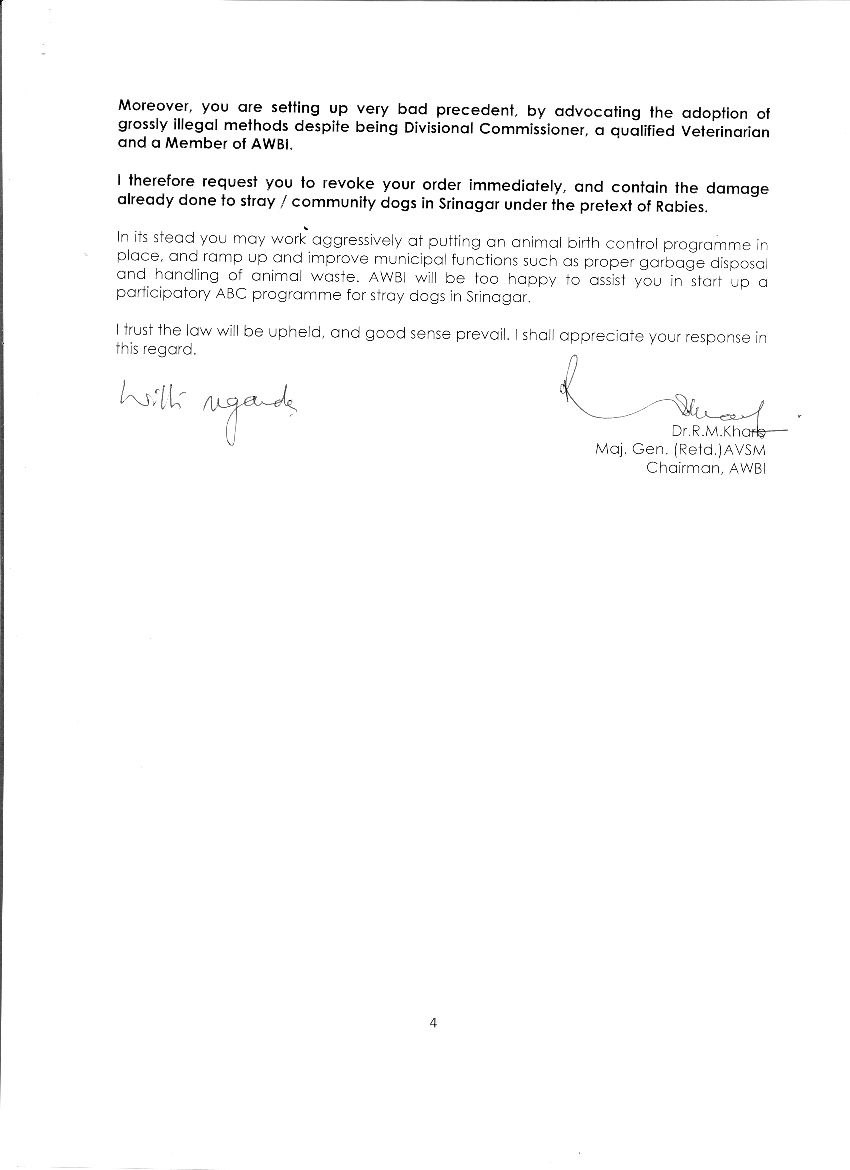
AWBI has also send notice to Dr. Samoon which is attached here.
-
-
AWBI Notice (Page 1)
-
-
AWBI Notice (Page 2)
-
-
AWBI Notice (Page 3)
-
-
AWBI Notice (Page 4)
Below are presented a series of articles that explan why Kashmir needs its street dogs…in a state which has been marred by violence, bloodshed and terrorism all these years, this state provoked bloodshed of innocent animals will only bring in more misery to the state. Read on..
Article in Greater Kashmir
Srinagar needs its street dogs. Here’s why …
Other opinion by Lisa Warden
Do you consider street dogs to be a barking, snarling, stinking menace? Do you wish they would all just get hauled off somewhere and be made to disappear? Perhaps you’re even one of the many people who support the poisoning of dogs. If so, then you are doing yourself and your family a distinct disservice. This is why:
People still die every year in India from rabies, the majority of those due to bites from infected dogs. Death from rabies is completely preventable; it’s a disease that has been eradicated in many parts of the world. Ironically, the best defense against rabies is not the absence of dogs, but their presence – the presence of vaccinated dogs, that is. Dogs that have been vaccinated against rabies actually serve to protect the human inhabitants of their neighborhoods from the disease.
How? Simple. Dogs are territorial creatures. They do not allow new dogs to migrate into their areas. If, in addition to anti-rabies vaccination, the dogs have been sterilized, they will not reproduce, and the dog population in your area will decrease naturally over time. The average life expectancy of a dog in urban India is only 3.4 years.
The killing of dogs does not work as a population control policy. It has never worked anywhere in the world that it has been undertaken, even when the numbers of dogs killed are in the tens of thousands. This is because dogs are so fertile that they simply repopulate the existing habitat in the subsequent breeding season.
Furthermore, in cities like Srinagar, where public sanitation is still a work in progress and there is ample garbage lying around, dogs perform an essential service, that of waste processing. Garbage is habitat. If there are no dogs in a place with lots of uncollected waste, nature will fill the vacuum with some other scavenger, inevitably one that is more problematic in its relationship to humans. Take what happened in Surat in 1994. The municipal authority made the decision to kill thousands of dogs. Cause led to effect: the rat population, all of a sudden blessed with a massive increase in available food (garbage), and thousands fewer predators (dogs), exploded. Bubonic plague eventually arrived on the scene, and hundreds of people were infected. Fifty-seven people died.
Are dogs ever a menace? Yes, and those that engage in bonafide, unprovoked, biting attacks on humans need to be removed from the population. This needs to be done by qualified animal welfare workers. However, the two most significant factors that result in dog bites – migration and mating – are actually exacerbated by killing or removing dogs, and failing miserably at the sterilization project.
Let me reiterate, if Kashmiris are serious about addressing the “dog menace” in their cities, killing dogs categorically will not work. This has been proven time and again the world over. The only solution that has been scientifically proven to eradicate rabies and decrease the street dog population has been large-scale sterilization and anti-rabies vaccination. Further, it is essential to the success of any intervention that the dogs be put back in their original locations following sterilization and anti-rabies vaccination.
Whether you love dogs or hate them, it is in your best interests to let your neighborhood dogs live in peace exactly where they are. You just need to ensure your municipal authority does its duty by sterilizing and vaccinating those dogs. Things will not get better until 75 per cent of the street dog population of Srinagar has been sterilized, vaccinated against rabies and left in peace, and until the municipal authority implements proper waste management reform.
(The author Lisa Warden is founder and director of DOGSTOP, a non-profit advisory group dedicated to rabies eradication and street dog population management in India. She also serves as advisor to ABC India, a pan-Indian organization devoted to the control of street dog populations throughout the country via large-scale sterilization and anti-rabies vaccination.)
Article in The Pioneer
Mass killing of loC that guard Kashmir
By Hiranmay Karlekar
The slaughter of street dogs in the Kashmir Valley calls for a full inquiry. The hapless animals served as watchdogs for the Army against infiltrators crossing the LoC and alerted security forces whenever danger was afoot.
The reported mass killing of stray dogs in Srinagar merits a serious probe. On September 22, 2009, a report in The Times of India by Ajay Sura had stated that stray dogs had become watchdogs for the Army against infiltrators crossing the Line of Control in Jammu & Kashmir. The report quoted Lt-Col NK Airy, spokesperson for the Army’s Tenth Division, as saying that these dogs recognised troops and local civilians and started barking whenever there was any movement of strangers. They were quick to train, easy to maintain, did not take a huge amount to procure and could not be recognised by the infiltrators as Army dogs.
Many Army officers have testified to the invaluable role of such dogs. One of them is Mr Habib Rehman, who began life in the Army and retired as the head of a well-known hotel chain. In his touching book, A Home for Gori, about a dog who adopted his family and became a deeply-loved member, he narrates how his love for dogs was awakened by his acquaintance with Bullet, which he made as a Second-Lieutenant posted in what is now Arunachal Pradesh. Every Army picket from the LoC in the north-west to Arunachal Pradesh in the north-east, had a dog like Bullet, a mongrel of Bhutia origin of the kind found all along the Himalayan ranges, as an additional member, rendering signal service in alerting it to an enemy’s approach and any other threats. A deep bond invariably develops between such canines and Army personnel.
In an article entitled The dog that did India proud in The Pioneer of March 24, 2007, Major-General Ashok Mehta (Retd) wrote fondly about Krupa, a Bakerwal puppy, who was picked up in 1963 and lovingly reared by a unit of the Gorkha Rifles serving along the LoC, then called the Ceasefire Line. Krupa did yeoman service not only with it but also the Sikh and Garhwal regiments that followed
Law enforcing authorities everywhere have acknowledged the important role played by stray dogs. As Director-General of Police, Andhra Pradesh, Mr Swaranjit Sen had advised police stations to adopt stray dogs for being alerted against approaching Maoists. Not surprisingly, Maoists in West Bengal had asked villagers to kill all village dogs. Even earlier, terrorists coming across the Line of Control had asked villagers close to it to kill their dogs; so had terrorists in Punjab.
The point in mentioning all this is the recent report in several newspapers of Sajjad Afghani, an important leader of Jaish-e-Mohammad, being killed along with this bodyguard, Omar Bilal, by the Jammu & Kashmir Police in an encounter on March 10. The reports quoted Mr RM Sahai, Inspector-General of Police, Kashmir, as saying that they were trying to set up a base in Srinagar “to carry out big strikes in the future on security force installations”. Was the killing of stray dogs meant to facilitate the strikes? The matter needs to be investigated because of the State Government’s shocking delay in entering into a partnership with the Animal Welfare Board of India in implementing the canine Animal Birth Control programme, the only effective means of controlling stray dog populations.
Terrorists have reason to oppose the programme which involves the neutering and vaccination (against rabies) of stray dogs and their return to where they had been picked up from. Implemented area-wise, it is calculated to taper off a city or State’s stray dog population as the neutered and vaccinated dogs live out their life-spans. This means that they will continue to remain in their areas for some years and continue to alert security forces to the approach of terrorists who, one hopes, would be routed by the time the dogs live out their biological life-spans.
On the other hand, as the Guidelines for Dog Population Management, jointly released by the World Health Organisation and the World Society for the Protection of Animals in 1990, killing never succeeds in providing a solution. What it can do, however, is a temporary reduction of stray dog populations in specific areas and thus help terrorist strikes. Is this the reason why some in Jammu & Kashmir oppose the implementation of the ABC programme and favour killing? If so, who are they? One needs to find out.
Article in The Pioneer
Stray dogs alert terrorists’ approach
By Hiranmay Karlekar
As several authorities cite that stray dogs warn of approaching terrorists, there is every possibility that terrorists are orchestrating not only a mass hysteria against stray dogs in Kashmir but also the demand for their killing
A report in Greater Kashmir of April 21, 2011, states, “The police top brass (on) Wednesday dispelled the notion given by some media agencies that the elimination of stray dogs would facilitate a rise in militancy”. The report did not mention the name of the agencies but carried quotes from my column in The Pioneer of 17 March on the mass killing of stray dogs in Srinagar, which clearly indicated that the reference was to the latter. The report further quoted a Deputy Inspector General of Jammu & Kashmir Police as saying that there was no relationship between stray dog populations and militancy, which were altogether different issues. It quoted the DIG, who described “dog menace” as a big issue”, as saying that it was for bodies like the Srinagar Municipal Corporation to “get rid of the problem.” The police was ready to help them in whatever way they wanted.
I will begin with reference to my column. The part of it which referred to terrorism in Kashmir, mentioned among other things, media accounts of the death of a JeM militant and his driver in an encounter with the police on March 10, and added, “The reports quoted Mr RM Sahai, Inspector General of Police, Kashmir, as saying that they were trying to set up a base in Srinagar ‘to carry out big strikes in the future on security force installations.’ Was the killing of stray dogs meant to facilitate the strikes?” Clearly, I was referring to efforts to set up bases to carry out big strikes and not, repeat not, increasing militancy. The two are entirely different things.
A terrorist strike is a single act. It is a part of militancy, which is a complex and wider phenomenon. At one level, militancy is the state of mind which is a blend of alienation, anger and aggression, prone to explode in violence. Since violence is an expression of militancy, the latter at the social context connotes a situation created by violence and the aggression associated with militancy. An increase in militancy means a rise in the incidence of militancy-related violence and the number of militants, as well as the spread and intensification of the aggressive mindset associated with militancy.
A single terrorist strike — or several strikes — however severe, need not indicate increasing militancy if more strikes do not follow. It is easier to organise a single or a couple of terrorist strikes than sustaining an increase in the level of militancy which requires the establishment of an infrastructure for procuring funds, arms, ammunition, explosives and the provision of electronic communication facilities through emails, phones and so on. It also requires propaganda for the militants’ cause, recruitment, training and indoctrination of terrorists and the organisation of shelters, false travel and identification documents, and storage of arms, explosives and so on. Nine-eleven in the United States and 7/11 (attacks on London’ underground subway system) in 2005 sent shockwaves throughout the world but did not lead to rising level of militancy in America and Britain.
Surprise is critical to the success of terrorist strikes. It can be neutralised by an efficient intelligence set-up which collects advance information and pre-empts terror strikes and destroys terrorists’ infrastructure. Equally, a strike can be neutralised if an alert is sounded as terrorists approach their target, enabling the security forces to repulse them. As several authorities cited in my column aver, stray dogs sound precisely such an alert. There is, therefore, every possibility that terrorists are orchestrating not only a mass hysteria against stray dogs in Kashmir but also the demand for their killing.
It is possible that the reporter, who did not understand what I had written, had also failed to understand what the DIG had said. If, however, the latter did say what he reportedly has, then he has betrayed a very narrow and conventional approach to counter-terrorism which ignores the complex and mutli-dimensional nature of the challenge. Referring to terrorism in India, Maj-Gen (Retd) Afsir Karim writes in his contribution entitled “Terrorism: the Indian Experience”, in Confronting Terrorism edited by Mr Maroof Raza, “The challenges of internal destabilisation, subversion, creation of administrative and economic chaos, and engineering divisions among diverse socio-political and ethnic groups cannot be met by conventional responses.” No further comments.





 JAAGRUTI® -