
Backgrounder on animal laws in India:
“The greatness of a nation is judged by the way it treats its animals”, said Mahatma Gandhi once as he was leading India through the country’s fight for independence from the colonial rulers. But long before animal activism became a global movement and animal laws were enacted in India in their present form, there are pointers that India as a nation has revered nature, its flora and fauna. The earliest laws of conservation date back to as early as 3rd Century B.C when Emperor Ashoka had banned killing and hunting of all animals in his kingdom. Images depicted in ancient Indian art and wall carvings, the notes and stories mentioned in Indian scriptures and fables like Panchatantra and Hitopdesha, all of these reflect the ethos of conservation and reverence for animals. But as India moves ahead in the rat-race for being a developed country, morals and ethos are being left behind and superseded by an insensitivity and egotistical attitude that is hard to comprehend.
Stand up against Cruelty to Animals
“Unseen they suffer, unheard they cry
In Agony they linger, in loneliness they die
Does it mean anything to you or anyone who passes by?”
These words penned above epitomize the pain, the suffering that millions of animals endure at the hand of humans every single day.
Though killing or torturing humans is considered to be a crime instantaneously, many amongst us perhaps pay mute witnesses to incidences of animal cruelty happening all around us. The fact is that laws do exist in this country of ours for protection of cruelty towards animals. The main laws are The Prevention of Cruelty to Animals Act, 1960 and the Wildlife Protection Act, 1972. However few people and even fewer policemen and lawyers are aware of these laws and in the wake of human ignorance on these laws, animals are helpless and fall victims to needs and deeds of humans.
Overloading donkeys with bricks, exhausting the elephant and camels with over riding in a a mela or at a tourist spot, whipping the horse and the bullock pulling the tonga or the cart, stuffing the cages with chickens in your local meat shop, transporting cattle and livestock one on top of the other in trucks while being taken to slaughterhouses or even treating your pet with neglect- not providing him food or water or chaining him in the sun, killing, maiming beating an animal…each of these acts is an act of animal cruelty under either Section 11 or Section 12 of the Prevention of Cruelty to Animals Act 1960 (PCA Act 1960).
PCA Act is a Central Act and is in force throughout the country/Indian territory. There are many rules drafted within this act that look into usage of animals in films i.e performing animal rules, transport of animals rules, rules for prevention of cruelty to draught and farm animals and many more. Though in terms of penal provisions these laws are still weak and in urgent need to be reformed, but that will only happen when public wants or asks for it as the animals themselves will never be able to do so, contrary to the activists who fight battles for laws to protect tribal rights or gay rights for that matter!
Many of you would have seen an overloaded mules or an overloaded bullock/horse cart on the roads every day. Most people prefer to ignore that sight but even when the very few who are aware of animal cruelty laws objects to the ‘owner’ of the animal being ill-treated to not to inflict their animal with cruelty, generally the owner objects loudly in retaliation! The reason behind this marked indifference on part of the ‘owner’ towards the pain and suffering of their very own animal is “because humans treat animals as ‘commodities’ and ‘machines’, something that they have purchased and they now ‘own’…something that they are within their rights to both, use as well as abuse!”, says Anjali Sharma, a senior advocate representing Animal Welfare Board of India.
Below is a list of what every citizen should do when they see someone inflicting cruelty upon animals:
1. Complain to the local state SPCA (Society for Prevention of Cruelty to Animals)/Animal Welfare Organisations working in your area, though as an entity an NGO can’t enforce the law, but they can put you in touch with an animal activist who deals in filing complaints and bringing attention to such matters with legal or media-based intervention. Importantly, Animal welfare Organisations and Animal hospitals can be contacted to provide relief to the suffering animal.
2. Contact the Police: On a national level, Police are the major enforcement body for the PCA Act 1960. They are obliged to take action against the offender and render help to the suffering animals as per the procedure outlined in the PCA Act when the offence against the animal is amongst those listed in Section 11 or 12 of the PCA Act. Police are even obliged to extend help to the enforcement staff of SPCA as well as ordinary citizens to lodge a complaint/FIR against an incident of animal cruelty. If the Police doesn’t adhere to your complaint, you can also contact the magistrate directly with a written complaint.
One can also lodge a complaint under Section 428 and 429 of the Indian Penal Code of 1860 under which, ‘mischief of killing or maiming an animal amounts to an offence’ and the offender can be imprisoned for upto five years or a fine or both.
3. Know the law: for example a donkey should be loaded with only 35 kgs of weight at one time; the permissible loading capacity of a truck is 4 buffaloes or 40 sheep/goats. Anything over and above it is technically illegal under the law.
Learn to make a distinction of cognizable and non-cognizable offences outlined in the PCA act 1960. Section 43 of Criminal Procedure Code empowers every citizen the right to perform a ‘citizen’s arrest’ i.e the right to arrest a person who has committed in their presence a ‘cognizable’ offence, an offence for which the offender can be arrested without a warrant.
Cognizable offences under PCA Act 1962 include the following:
a) Under Section 12 of the PCA Act, 1962, injecting oxytocin injections to cows/milch animals, to improve lactation/milk-giving capacity – which is injurious to health of the animal or permitting such operation to be performed by any other person on the animal he/she ‘owns’ is a cognizable offence. However, this may be one of the most common things that you see used by local legal/illegal dairy owners throughout the country.
b) Under Section 11(1)(l), mutilating or killing any animal, including stray dogs by using poisoning methods or any other unnecessarily cruel means
c) Under Section 11(1)(n) organizing/keeping/using any place for animal fighting/baiting and receiving money on the same.
d) Under Section 11(1)(o), promoting or taking part in any shooting match or competition wherein animals are released from captivity for the purpose of shooting/killing.
4. Documentation is the ‘Key’: In your complaint, be as factual and precise of your observation of the animal crime. Give precise dates, times, locations and photographic evidence if any (while remembering to keep a photocopy with yourself). You are also advised to keep a record of all the officers you are interacting with so that if they don’t listen you can proceed to the next level in the hierarchy to demand justice for the animal/s you are fighting for. Getting a vet’s certificate for the animal in consideration would also prove to be good documentary and supporting evidence.
When reporting animal cruelty, we should look out for the following: Physical condition of the animal, telltale signs of animal cruelty, cruelty during their training and practice, housing (size of cages), overcrowding, mode of transportation, sanitation and hygiene.
5. Stand up, speak up against injustice. Never give up, keep up the effort!
The Indian Constitution, also, under Article 51 A (g) imposes upon every Indian Citizen a fundamental duty to have compassion for all living creatures. But, from subjecting animals to meaningless experiments in cosmetic-testing laboratories to killing one animal in front of the other in an illegal slaughterhouse, from holding cockfights to boiling monitor lizards alive to extract oil from their bodies, mankind does it all and that too shamelessly. It is for us who are aware and informed to keep our comforts aside momentarily and become the voice for these mute, speechless animals as they wage their lonely hopeless battle against the all powerful ‘man’.
What makes cruelty to animals morally unpardonable and unacceptable, over and above human cruelty? Humans can still protest against cruelty meted out to them, they have a voice to raise alarm, hands to hit back. The animals sadly don’t have those options either, so in effect they are defenseless in the face of the cruelty humans mete out to them, be it for their own pleasure, benefit or to fulfill their sadistic desires!
Fyodor Dostoevsky once said that, “no animal could ever be as cruel as a man, so artfully, so artistically cruel.” One would agree to it as Advocate Anjali Sharma concludes, “Perhaps humans are the worst animals ever born on this planet”.
“I don’t believe in the concept of hell, but if I did, I think it would be filled with humans who are cruel to animals”- Gary Larson
Some words of wisdom by Ms. Gauri Maulekhi, an animal welfare activist are penned below:
“When you report cruelty, don’t stop at the that. The courts generally give custody of the animal back to the owner at the first hearing. Lawyers make you go round and round with procedures and often lose sight of the objective altogether. Get involved at every step. Understand the procedure yourself.
You do not need an LLB to understand the law. Its YOUR case. Be aggressive. Be proactive. Don’t leave things to the lawyers, prosecution or otherwise. Activists must be there to push things around.
PCA Act can be read and understood by a 15 year old and with some experience an activist will know more about the implementation and arguments than any lawyer. Be there to brief and update the advocate who appears on your behalf. Be prepared for argument yourself. Be present at the court to ensure that your advocate turns up. Be alert to notice if the procedures listed by him are genuine.
Fight the cases for custody or conviction as if your life depended on it. If you cant find an advocate at the last minute, do not panic. Prepare a defense and argue yourself. Its easy and effective if you have done your homework. Whatever you do, remain involved till the animal is PERMANENTLY out of danger.”
Article by Vasudha Mehta/ ‘Jaagruti’
 JAAGRUTI® -
I love only animals and abhor those that treat them cruelly like the guard in this story: http://www.indianexpress.com/news/noida-guard-tries-to-silence-barking-dog-w/537346/
LikeLiked by 1 person
A lady killed jermen shaffed. When i handle her stickely she off her phone. I wanna sonething . I cant bear if animels toucherd by anyone. Stick rules should for all. But peoples so shit nature. I want something about animels. I cant sleep anf eat when animels beaten or toucher by peoples
LikeLike
Which area of which city did this crime occur in? Why haven’t you lodged a police complaint against this woman under Section 429 of Indian penal Code and Section 11 ( 1 ) of Prevention of Cruelty to Animals Act yet?
LikeLike
madhu my friend lets we should be a team to protect them.if u need my help then connect with me on facebook.my name is putuldas mallik.west bengal.
LikeLike
You are absolutely right sir. I am also like. I can’t tolerate seeing any animal’s suffering. I want to end this animal suffering by the government by implementing strict laws
LikeLike
Hello need help relating complaint process. In miraroad thane their is big bldg project at vinay nagar JP north bldg name atria. Their r stray dogs in bldg which stay outside bldg on road all dogs r STERLIZE and vaccine done. This dogs from in this complex from last 5 years in bldg their are some dog lovers who feed them daily but some people in bldg they object and daily beat with sticks bamboo and stones to dogs. So need some help how to tcakl this situation
LikeLike
Please connect with Nilesh Bhanage of PAWS THANE ON 9820161114
LikeLike
Hi we left our dogs in a kennel but they lost the dog and started saying that the dogs breed is at fault and it is a very bad kennel and when we found the dog she has a highly fractured leg..they cage all the dogs in very small cages ..she is into breeding and not for taking care of them..kindly help me with what legal action i can proceed.
LikeLike
You need to approach the Consumer Court against them
LikeLike
Yes, you are absolutely correct. People don’t even care to hurt those little puppies on streets, and I hope the same happens to them, I hope they also get hit by someone, these people are shameless and inhuman
LikeLike
On the way to saniswaram from shirdi ,we found a group of people torturing bulls by making them to lift heavy loads of sigar cane grown here.Bulls are unable to lift the loads.We found a bull fell down as it is unable to lift the load.The heads of the bulls are in crossed position indicating that they are unable to lift the load..Please look into the issue.This made my whole family sad.
LikeLike
Which state or district is this? Do you have photographic evidence?
LikeLike
I see every day the pets like cat, dog is being lonely without any one that owns, because they living lonely, that time they met several accident and they some time died, because they have not owner. this seen is very hurt my heart and can’t help them and take care them, because i am poor and have not owned house, but i feel every one will take care with safety. please help me what can i do 8508844705
LikeLike
Do whatever best you can. Hands that help are better than lips that pray.
LikeLike
Well I do not typically comment on weblogs but I came across yours while I was doing a bit of work researching in Bing today therefore i figured I might shoot a quick note. Obviously I have gotten a tad sidetracked after sticking around to browse a few of your articles. Carry on the excellent writing and i am already looking forward to checking out future posts. Many thanks!
LikeLike
Excellent article.
We would like to use it as well for our magazine which caters to animal lovers.
We condemn such act and try to inform our readers of the same from time to time in our magazine.
LikeLike
Thank you. Please attribute credit to Jaagruti and the author.
Also let us know the name of your magazine and kindly send us the copy of the same (a scanned copy would be fine as well- to jaagrutiindia@gmail.com). Thanks
LikeLike
my dog hasent been relesed she has been picked up bt bmc vans 4 the operation its been 5-6 days when do the relese the dogs
LikeLike
Please go and follow up with them ASAP. Don’t waste time waiting. If you trace your dog get them back on your own
LikeLike
Incase you are interested in putting up articles and information regarding animal cruelties and how to deal with it please contact me on hbilimoria@gmail.com. I can give you a lot of information as I have worked on ground level in rescue of Animals.
LikeLike
Please also email us “How to Do/Do it Yourself” articles of your case studies and experiences on contact@jaagruti.org, if you wish to make us all more informed
LikeLike
i am mou roy, my home is bangur avenue, my nearest belling s hav a pet dog, they r harrege ther dog, every moment, no tretment,no food, pleace help that dog, as soon as possibele, that address is 100 &101 bangur avenue,block c kol-55, may mob number is 9830491886
LikeLike
Please lodge a police complaint as explained in the article above.
LikeLike
Animals only need love from human beings.so please keep loving them. I am 100%sure they will also give u love in return.
LikeLike
Hello ma’am , we are college students residing in Kolkata. We’ve taken an initiative to put a stop to animal cruelty in the city by crowding people for a walk while feeding the strays and medically treating the ones in need. As novices we have a long way to go but we’ve successfully organised one walk since our group formed a month ago. We would love to hear from an expert such as yourself. Please do look at our page –
http://www.facebook.com/bluechuckles
Or simply search walk Against Animal cruelty (WAAC)
LikeLike
Sure. We will browse through your link. All the very best.
LikeLike
Thank you.We got much needed information from the article.Certainly will make use of the act against people indulged in cruelty to animal.If there is any magzine related with the subject kindly send the address for subscription.
LikeLike
Thank you Sir. You could order/subscribe to AWBI’s (Animal Welfare Board of India’s )publications by filling the subscription form available on this link http://awbi.org/index.php?q=node/45, they come out with an English magazine called ‘Animal Citizen’ and a Hindi magazine called ‘Jeev Saarthi’ besides newsletters on a monthly basis.
LikeLike
thankyou so much i got so much help from ur article for my project work.
LikeLike
Glad to hear that Komal.
LikeLike
good morning mam
just happen to see your site.its really nice and informative.
regards
rashmi
LikeLike
Dear mam, can you inform me where to send complaint of the cruelty in the slaughtering house in kerala which i had seen in the facebook by one of my friend
LikeLike
Try your luck by sending it to AWBI-The Animal Welfare Board of India- http://www.awbi.org
LikeLike
thanks alot i really love animals as i was not known to law i just fought with the people who beats and tortures street dogs.now because of your site i will make punish those who trotures animals..thnks alot.madhvi
LikeLike
The Secretary of Port Blair Municipal Council frames had hikes the charges of cattle pound with a new rule that if a cattle is been impounded then the charges for releasing the cow will be Rs. 500 + 100 for per day feeding charges for 7 days compulsory, whereas the earlier charges was Rs. 250 with no feeding charges and can be released at any time by paying the penalty. But the new policy says that if cattle impounded then it will be in the cattle pound for 7 days compulsory and moreover there is no provision of providing feeding and clean drinking water in the cattle pound.
My 3yrs. Old Calf has been impounded in the cattle pound, 2days back, (i.e on 07.4.2012) near to my house at nayagaon Port Blair, when we gone to release him, they denied to release by saying the secreary Municipal council told to keppt all animals verbally to kept for 7 days without any written order,for which Rs. 250 for Calf and per day feeding charges of 7 days has to be paid. Isn’t this ridiculous. No logic to give punishment to animals as they r unware of it.
sanjay
Port Blair
LikeLike
amazing site,,,god bless you for your love and kindness to animals
James
United States
LikeLike
Thank you James
LikeLike
Heart touching lines.we all born being a man but not yet became a human. we think the almighty has created us for us…certainly not it is but has created us protect His all creatures. i vowed to do something for the welfare of other creatures of god .
LikeLike
HI all
I have read most of the replies. As we all animal lovers, Can we make an independent group to make the PCA ACT strong? It can not be one man army. We have to come together. Its realy high time.They need us. If anyone agrees then do ans.
God bless all
LikeLike
How do you propose this group be formed and ensured that it will work and not become another Facebook mediated group in which there is all talk and no work on the ground.
LikeLike
hi friend i agree with u ..we have to come together to help animal
dear frnd plz tell me how to help a stray dog suffering from severe wound
09897905711
plz inform via sms
LikeLike
Hi my name is Shilpa Garg. I just read your message.we all are animals lover.and your idea was fab.if you making any group please inform me.I would like to join.
LikeLike
Please give me your contact number I am kirti yadav.
There has been a very harsh torcher on a monkey please help me fight for him . We can make a strong group and fight for that monkey.
DAYE 02|01|2018.
CONTACT NO. 8770638051.
LikeLike
Hi all, be a newbie on this site i would like to share a tragic incident with you that took place just 2 days back in my hometown in my absence. Actually i m in new delhi now and my hometown is in himachal pradesh. As you all know the winters are on its full and people are shivering these days. During this season all the shepherds from high hill areas comes to plain areas to avoid the worst seasonal situation that arises due to high snowfall on peaks. Thus few shephered were also residing near our houses in open farms with their cattles and sheeps. In the same locality a 2.5 year old bitch used to live with her 2 little puppies of around 1.5 months old(frankly they were very sweet). And the worst thing happened when the very next day when i came to delhi from hometown. I just shocked upon hearing the tragic or you can say the brutal killing of those little puppies along with their mother. You cant believe i am writing this mail with tears in eyes. Upon examining here and there from reliable sources i found that those shephereds had poisoned them by keepiing the probability of them(dogs) hurting their sheeps and cattles. This is totaly beyond humanity and had arouse sadness all around me and my friends, neighbours. Can anyone suggest me here what should be done to teach them a rigid or solid lesson. Please reply soon as i am waiting four your opinions………….
LikeLike
Please lodge a complaint against these people under the Indian Penal Code Sections 428 and 429 as you have read on this article: Under Section 428 and 429 of the Indian Penal Code of 1860, ‘mischief of killing or maiming an animal amounts to an offence’ and the offender can be imprisoned for upto five years or a fine or both.
LikeLike
Hi. Am Ruchira residing at pune. Recvd ur link frm a frnd of mine n was going through the posts. Animals r really treated very badly in our country n without a justice. Police here not at all ready to spend their time for the animals as they r not ready for us either.
What i feel wud help us (the common animal lovers) is if we can make a list of active NGOs of every city possible. Then one can find n contact them at the time of need n rescue or fight with their help. Alone doing something is not always possible as most of the neighbours r also anti pet minded . Most of the NGOs r found to be having different interests in the name of animal welfare. Sometimes do feel frustrated when see things wrong but cant help.
Ruchira
LikeLike
We understand Ruchira, it’s tough to find honest organisations but all organisations have their limitations and hardships too. See if you can make a good list, we will be happy to share it as well.
LikeLike
I came across this wonderful article looking for some help against animal’s cruelty. i am fed up of fighting / arguing with people i dont even know..cant believe how mean we human can be to these innocent & helpless animals..is there any way we can stop this..am totally freaked & upset with what i witnessed today..and just cant get over it..anyway..pls help me with some numbers in kolkata where i can contact for help against cruelty to animals..pls help..
LikeLike
Thanks. In Kolkata, you may try contacting http://www.animalcrusaders.org/office.html and see if they are willing to guide/help you anyways.
LikeLike
Dear Jaagruti
while this article is very informative and an eye opener to those who dont know much about laws preventing animal cruelty-i am sorry to say that no one really comes forward when contacted-i am an animal lover and care for some street dogs near my home, sometimes others also come by, but being territorial in nature-the dogs presently there-dont allow outsiders to stay.
now the point is how do you educate a bunch of ignorant animal haters. i face so much abuse and disgust from my neighbours all who just want to get rid of the dogs-as for police, when i told them about the
problem-they adviced ‘madam kyo musibath leh rahi ho-do-char kass ke danda maar do aur bhaga do en kutto ko’ so i contact PFA to help and get abused by the most undignified woman heading PFA, she called me pagal aurat and kutiya, haramjadi-and yes i can prove this from my call records of 19th November, 2012. it is disgusting when so called animal activists and care givers also avoid assisting in dire cases. in my opinion-those people wanting to harm stray animals have the right to do it since no one cares-
has anyone ever bothered to penalize those that keep cows and when they are milked, just left to roam on the roads making a mess and causing traffic woes.
this is an action which has to be done jointly by the govt and animal welfare, not just a handful of animal lovers who are shuned by both-govt and animal activists who make excuses about shelters being over crowded and infectious or lack of funds-this is a call they have taken to do something for stray animals, yes agreed that this is not an easy task and with very little support its really hard to manage, but places like friendicoes, sanjay gandhi animal shelter and jeev ashram have a lot of funding from foriegn sources and can help to a great extent but wiwill not-at least when its a desperate call they should come forth without even asking questions, but no-they will make all the excuses and ask to caller to call some other place or person.
frankly i could go on about issues and the trauma i have faced when dealing with horrible neighbours and equally useless animal activists.
the need of the day is to form teams to educate people about how to handle stray dogs-the solution is not to kill or beat them. they need to be taken and neutered/spayed and brought back to their areas-i have also observed some dogs in Rajinder Nagar area how have collars put on, they are strays and look ok-BUT i notice that the collars are very tight, some of them are choking on them-i assume these collars are put on by the mcd, i wish someone would take note and put the collar on loosely so if the dog grows bigger, there is enough space, these dogs dont allow people to touch them hence no one can losen the collar.
thank you for your patience to go thru my mail.
LikeLike
i see boys throwing stones at poor puppies and dogs!
what should i do in that case?
who to complain?
LikeLike
You should gently try and speak to those boys first and tell them not to do so, speak in the language they will listen and understand…sometimes a gentle kind request does help…try atleast…they are after all little beings, it is very insensitive of people to be hurting them, infact they need to be looked after and nurtured…fights don’t help resolve situations like these, sometimes just gentle requests help drive home the point.
LikeLike
The spca in your area
LikeLike
Not all districts have SPCA’s though
LikeLike
doctor Shalala More killed my cat because she said cat is 10 years old that reason she said, I just went Dr.Shalaka More clinic for CAT checkup and she gave heavy dose medicine without any interaction, so plz help me on this case bcoz police also can’t help I have avoidance again Dr. Shalaka More my number is 7506747828
LikeLike
Please lodge a complaint with the State Veterinary Council and Veterinary Council of India
LikeLike
I have recently come across a MMS clip being forwarded on social media where it is seen that few boys have pushed a donkey over a bridge into the river. The video is quite disturbing and is shot in totally bad taste. I believe strict action should be taken against the culprits. Their faces can be seen in video. I would have given the link to video right away but I do not want that video to publicized and circulated as it may start a series of events against stray animals.
I do not know how we can complain against this. The police will not entertain the case giving jurisdictional excuses. We need some central authority to investigate the case and find out where the video was shot and who are the culprits.
LikeLike
You can report abuse to the networks hosting this video , or wherever this video is uploaded…be it Facebook or YouTube. The networks normally end up removing crap if they think it is promoting violence like the one you describe.
LikeLike
My Makan owner has a dog, he treats him very badly. Oh, and do not give him food or water keeps him hungry all day. does not even clean. his health is getting worse. What should I do for that dog?
LikeLiked by 1 person
Which city are you writing from? Doing what your landlord is doing is illegal under the Indian Prevention of Cruelty to Animals Act 1960, you can take a copy of that act and gently reason it out with your landlord, do it subtly and tactfully, say you heard on Radio that you people can lodge complaints on such cases and thought of warning him, that he either takes care of his pet properly or organisations may take action…see what happens, may be this gentle yet clever use of words from your end, will convey the lesson to the landlord and also prevent you from burning any bridges with him…or the alternative is as described in this article, that you lodge a complaint against this person with photo-proofs to organisations like People for Animals and the Local Police Station and they come and speak to this person, but that would mean you being chucked out of this rented accommodation…choose your options.
LikeLike
I live at Hyderabad, the Hitech city which is populated by IT parks. There is a house at the backside of my hostel. They have around 6 buffalo and 2 little calves. Hyderabad is a place where it rains heavily or leaving it with scotching Sun. I feel pity at these ones who stand by the side of the road. They have just them on the road with no shelter or roof cover. They stand all day and night in that Sun and Rain. These guys are enjoying the privilege of its milk and earning in all possibilities. I have no clue of what to be done for these pity creations.
LikeLike
You should try and speak to the owners once atleast and request them to show compassion towards these animals who add to their income and install a shed for them…the least that they can do
LikeLike
Else what these bufaalo owners are doing amounts to cruelty under the Indian Prevention of Cruelty to Animals Act 1960…in which ‘cruelty aspect’ is in not providing adequate shade to their pet etc.
LikeLike
Where do I ask help when dog is seriously injured. Whom to contact in my city Karnataka, Mangalore
LikeLike
Sorry we have no clue on this…maybe you can connect with http://www.fiapo.org or bangalore based http://www.strays.in for advice
LikeLike
Contact Vatsala animal centre Shakti Nagar in mangalore no other shelter home here so no choice .
LikeLike
hello iam sanjay from kolkata feel nice and very much emotional to think about people like YOU who care about own environment it’s inhabitants and very special creatures like US,stray animals uncared pets tortured tames dejected companions and so many to say
here i would like to say and share about self feelings about domesticated/stray animals who are treated just like naything by their owners/passer bys as these acts of ignorance,inhuman and uncivilization just shake me from within and often i thought whether we have managed to make an edge/upper hand over this real living beings or we are just setting our bar much below them ?
it is a big question unless and untill we altogether try to abolish the sense/act of dejection,ignorance,unsensible acts to these much loving and moving creatures
JUST A BIG QUESTION TO THIS CIVILIZED SOCIETY
LikeLike
this article has been of great help. me and my husband are staying in salem to do our post graduate degrees and we happened to feed few stray dogs (a mother dog and 3 pups of which one is blind)..here the neighbours are cruelly abusing these animals.. they keep shouting at us too..I HAVE SEEN THEM STONING THOSE POOR DOGS.and now one is limbing..i was wondering if anything can be done.here. the police is also lax. and we are from kerala.. living temporarily in tamilnadu,,if i could get a local number of some society it would have been of great help..
LikeLike
Mam, we suggest you connect with Dr.Chinny Krishna at Blue Cross of India at Chennai. He is also the Vice President of Animal Welfare Board of India. He can help warn these people who are harming the dogs and apprise them on the laws of the land. Also at your level, please make the effort to get the female dogs in your area sterilized…so that thete are no more puppies getting born and the ones that are there live a good life
LikeLike
Chinny Sir’s number is +919840042228
LikeLike
I need to complain against some cruelty happening with a pet dog but family members don’t allow me doin so… Ian there any way I can complain without telling my identity???? Pls reply
LikeLike
May be you can approach People for Animals Headquarters 01123355883
LikeLike
If I complain in police will they take action. And will my id will be anonymous. And if they don’t take action on animal abuse what should I do. I live in Gorakhpur, Uttar Pradesh and I don’t find any organisation that help me in treatment for dogs or complain for animal abuse. And I don’t believe that police will co-operate with me for animal abuse.
LikeLike
Please connect with us over the email contact@jaagruti.org
LikeLike
7 puppy’s are missing from our society and our neighbor is doing so where should i laughed the complaint and what will be the procedure after complaint please reply as soon as possible i am from north Delhi rohini area and the person who is doing this is a residence of g-1 block sector 16 rohini his name is Mr tiwari and Raj kumar sharma
LikeLike
Please connect with Madam named Ms. Ambika Shukla of People for Animals 9810054077..please keep the mobile number of the wrongdoer handy with you when you call her.
LikeLike
i am really touched by this effort of yours . i am really glad now as no one in our locality can fight with or warn me for feeding stray dogs because now i can answer them much confidently (as i know stray animals too have a right and feeding them is not an offense) . it would be great help if u let me know which organization is undertaking all such work in Punjab so that i can help the stray dogs more efficiently . i have to come to know about a dog whose front legs got broken last month . can he recover ? (reply asap) with a hope. thanks
LikeLike
You can check with Ms.Payal Sodhi at PFA Chandigarh (please google them, they have a website), if their hospital can take the dog in..if its already too late sibce tge legs got fractured, then perhaps you can get carts made from Innovation India, will give you their web address too in some time
LikeLike
ma’am , i got the dog treated , i want to know whether anyone is working in our city PATIALA (PUNJAB) for the welfare of stray animals ??
LikeLike
You can check with PFA Ludhiana or PFA Chandigarh on the same (https://www.facebook.com/pages/People-For-Animals-Ludhiana-PFA/167748553281408?id=167748553281408&sk=info – Sood A.K- +91-76-960487470 Mr.Ajay Jain +91-9815021905 (President))
LikeLike
I am from Kamothe in Navi Mumbai. We have a rather psychic couple living in the opposite apartment block who keep their dogs chained throughout the day and night in the balcony. The dogs keep whining and barking. I have complained to them about this once but their attitude does not seem to have changed. Which animal activist / organization can I contact who can help me take up the issue again with this couple?
LikeLike
You can contact Nilesh at PAWS Thane 9820161114, his organisation may help intervene on this
LikeLike
Dear Mam, I live in Ahmedabad Gujarat. All together I take care of about 75 to 80 dogs. 14 dogs in our society and other dogs out around the area on the streets. My family and I make Rotis for all of them at home and at evening we feed the dogs on the street every single day no matter summer, winter or monsoon. We also take care of them if they are injured we call doctors we buy medications for them and do all that we can to help them.
There are 14 dogs in our society 6 older and 8 puppies are only a month old. My family and I are taking care of these dogs just like any other family members as they seat at our door all day and night. We feed them any or everytime they are hungry. They even stay inside the house play around sleep eat and during the rain they stay in the house all the time.
People in our society are so cruel they badly beat up these dogs. Sometimes they beat them up with some wood sticks or sometimes with iron Or some kind of metal rods. One of the old dog was beaten so badly with few people under his tail area that he never got cured itself and we didn’t noticed the injury under his tail and he had to under go some surgery
Also just because we don’t beat the dogs we feed them and let them stay at our doors people in the society treat us like we are terrorist. They don’t involve us in any society functions or meetings. Also they throw wood sticks or rods or stones at our doors also know our door early in the morning about 6 or so to fight us that oh dog has vomited on the common walk side of the society so to go and clean it.
Also if we are feeding the dogs out side the society around the area on the road they stay on the street and laugh at me saying look at the crazy girl and curses me with bunch of ad words
Also people come right and front of our entrance area and shout and say that oh as soon as anyone see the dog walking out just break the foot hit so hard and Kill all of them one by one
Also these three female dogs have given puppies they are only a month old. They had given birth to puppies right on our entrance side on porch and in the backyard … but now I am scare the puppies try to go out of the gate and people are trying to beat them up
What should we do to help the innocent dogs???
Is feeding the hungry is that bad act that we have to go through all these??
My family is being harrash So badly by all the cruel and cursing words from the morning to night
If we say anything like don’t hit the dogs what they have done to you .. they say oh the dogs make too much noise at night or oh 1 of the dog goes potty in the society therefore they want to kill them
And saying that there should be no dogs in the society at all and just because we are taking care of them they want our landlord to throw us out of the house
Also if we try to protect the dogs they threaten us that oh we dont know who they are or who their relatives are … Some says they have relations in Congress party some says in bhajap party
Kindly let me know what to do ???
There are only rules written in files or they are really being followed by anyone ….cause where I feed dogs around the area the people from some gov agencies took some of my dogs for ABC program.. also took one newly born puppy and his mother and never returned my dogs back to the area. When I call them they said they never took the dogs from that area. When I gave them proof that I have people saw them taking my dogs they said OK will return your dogs in 2 days and never returned for a week then when I called again said oh left them since long back and don’t know where they are .. when I asked them again and again said oh we are doing favours and you are talking to us like these and you know how our government is not paying us enough and so and so then I still didn’t listen to them and told them will take this to police they threaten me that OK go to police and see what happens to you next. You don’t know said some commissioner is with us and your complaint will never raise its voice and you will be troubled so badly that you can never think of … and due to all these my family held me back and didn’t let me call them again
Can you please honestly tell me what action can I take against these cruelty around here or if there is no hope for justice ???
After reading things at your site … I at least hope that I would find an honest answer from you
Thanks a lot
LikeLike
Please do not lose hope, you need to be strong and fight this out.
You need to approach the Police and file an F.I.R against all the people who are harassing you, threatening to kill/harm you and the dogs you care for. Since you are a woman, please also read up and lodge a complaint Under Section 509 of the Indian Penal Code ( “Word, gesture or act intended to insult the modesty of a woman” – as offences under this section are cognizable), all the abuses hurled at you by these neighbourhood residents tantamount to this..
Also file a Police Complaint(FIR in case of Cognizable Offence) against the local Municipal Corporation (If you know whom you spoke to in the Municipality who said dogs were taken away and will be returned and then didn’t return, that will add more credibility to your complaint). Be sure to mention full names and addresses of all the people who are harassing you and give complete true account of the matter, without exaggerating facts – take help of the points stated below to put your grievances and facts across and mention why you are seeking help from the Police and reporting this matter.

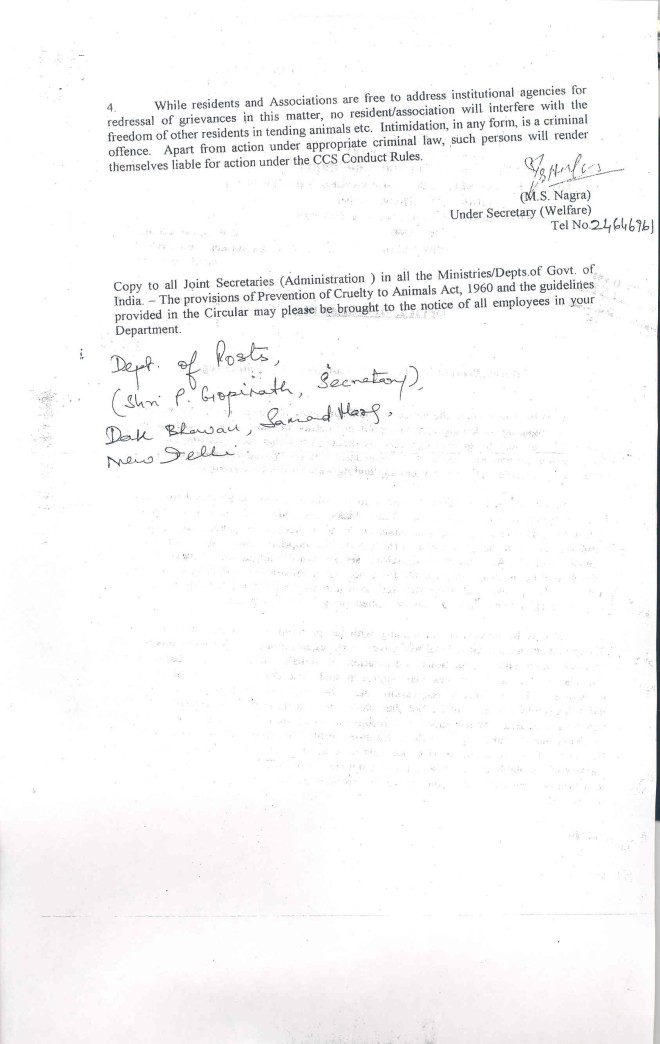
There is no law that prohibits feeding of street animals, and citizens who choose to do so are in fact performing a duty cast upon them by the Constitution of India. Persons, who are trying to interfere with their effort, or display aggression, can be held liable for having committed the offense described in the Indian Penal Code and criminal intimidation.
Moreover, as per Indian law, street dogs cannot be beaten or driven away. They can merely be sterilized in the manner envisaged in the Animal Birth Control (Dogs) Rules, 2001 (Rules under Indian Prevention of Cruelty to Animals Act (PCA), 1960), vaccinated, and then returned back to their original locations.
If your municipality is not doing the same, you can file an FIR against the local Municipal Corporation for flouting the laws and rules mentioned above (Which need to be complied with throughout the country, as PCA Act is a Central Act, i.e. it is applicable across the country and the local Police has been mandated with the responsibility of enforcing this act and reporting/booking violations/offenders)
Article 51A of the Constitutional Law of India, speaks about the duties of every citizen of India. One of these duties includes having compassion for living creatures (Article 51 A (g) of the Indian Constitution). Those who look after animals and other creatures of God are thus protected under the Constitution.
Article 19 of the Constitution of India, deals with right to freedom and in this freedom are included the right to profession, occupation, trade and business. Therefore, it means that every citizen has the right to occupation and if someone has taken the caring of animals as his occupation, it is legal and he has every right to carry on with his occupation.
Section 503 of Indian Penal Code read with Section 506 of the Indian Penal Code 1860, provides that intimidation is a criminal offence.
In a Judgment passed by the Delhi Court, it has been stated that the Animal Welfare Board of India and the Municipal Authorities have in the guidelines issued by them specified the problem often faced by individuals and families who adopt and feed stray animals. The court says that it is necessary to bring into record that these individuals and families who adopt stray animals are doing a great service to humanity as they are acting in the aid and assistance of Municipal Authorities by providing these animals with food and shelter and also by getting them vaccinated and sterilized. Without assistance of such persons no local Municipal Authority can successfully carry out its ABC programme. The Court has proceeded to say that the local police and the municipal authorities are under obligation not only to encourage such adoption but also to ensure protection to such persons who come forward to take care of these animals specifically the community or neighborhood dogs so that they are not subjected to any kind of cruelty, finally, the Court has said that every individual has the right to live his life in the manner he wants and it is necessary that the society and the community recognize it.
Under the Govt. of India, Animal Birth Control Rules 2001 (drafted under the Indian Prevention of Cruelty to Animals Act 1960), no sterilized dogs can be relocated from their area. As per five different High Court orders, sterilized dogs have to remain in their original areas. If the dog is not sterilized, the Society can simply ask an animal welfare organization to sterilize and vaccinate the dog. They cannot relocate them. Relocation is not permissible, as it would cause more problems such as an increase in dog bites as new dogs will move into the area who are unfamiliar with residents and therefore more likely to be hostile. All problems of stray animals have to be handled within the institutional framework available. No association, recognized or unrecognized, shall take recourse to any action regarding stray animals on their own, either themselves or through any person employed by them like security guards. While residents and Associations are free to address institutional agencies for redressal of grievances in this matter, no resident/association will interfere with the freedom of other residents in caring and attending animals.
Section 11 of The Prevention of Cruelty to Animals Act, 1960 forbids the displacement of Animals from its natural environment into an environment that is hostile to it, where the animal may be injured/hurt/maimed or killed due to lack of food or fights with other animals.
Additionally, Section 429 of the Indian Penal Code also provides for imprisonment and fine, in cases involving animal cruelty. Section 429 in The Indian Penal Code, 1860, a Central Government Act, reads as follows:
“Mischief by killing or maiming cattle, etc., of any value or any animal of the value of fifty rupees.– Whoever commits mischief by killing, poisoning, maiming or rendering useless, any elephant, camel, horse, mule, buffalo, bull, cow or ox, whatever may be the value thereof, of any other animal of the value of fifty rupees or upwards, shall be punished with imprisonment or either description for a term which may extend to five years, or with fine, or with both.”
Following are some of the self-explanatory documents that one can look up:
1. A 2 page circular issued by the Ministry of Personnel, Public Grievances, and Training, on the aspect of street animal feeding and prohibits central government employees from harassing street dogs or those feeding/looking after them.
2. The Animal Birth Control (Dogs) Rules, 2001.
Click to access the-animal-birth-control-dogs-rules-2001.pdf
3. A directive issued by the Animal Welfare Board of India, constituted by the Ministry of Environment and Forests- provides immunity to animal feeders and restricts RWAs from harassing people tending to dogs.
Click to access awbi-direction.pdf
4. M.C.D. (Municipal Corporation of Delhi) notification, showing the approach of the M.C.D. with regard to street animals, which is based on the law of the land.

5. A Times of India news report regarding a Delhi High Court direction to the police to protect persons who feed stray dogs.
Click to access times-of-india-article-on-feeding.pdf
6. A Hindustan Times news report regarding the view taken by the Supreme Court regarding stray dogs.

7. An order passed by the Additional Chief Metropolitan Magistrate, Delhi.
Click to access addln-chief-metropolitan-magistrates-order-on-street-dogs-of-india.pdf
LikeLike
Thank you very much for all your helpful guidelines. I really appreciate it.
Can you please kindly send me your contact details would like my family to speak to you. They are been suffering all these harrashments from past
2 years and have lost hope . Would like you to guide them through all these please. Also they think that I shouldn’t take… any action as no one will listen to me but you can make them see the facts that there are some people out there to hear me
Also can you kindly provide me some NGO or some activist contacts in Ahmedabad where I can go seek for help
If you can even mail me the details will be a great help for my family, I and for all my dogs on the streets around the area
Once again thanks a lot for all your help
LikeLike
Yes..We are checking as to whom can we put you in touch with in Ahmedabad who can stand by you to fight this mess. Also, you can call us on our helpline number 9818 144 244
LikeLike
Good morning, I am a south African citizen and is currently working in India rujustan. This state has a huge problem with animal cruelty. Livestock aswell as dogs are beaten and kicked. The dogs have skin problems and are not fed or given fresh water. I would like to have more information on what can be done.
LikeLike
Which city are you based out of in Rajasthan?
LikeLike
You can cure there skin problems using Neomec (10rs a tablet) melt in the mouth veterinary tablets, 1 tablet per 20kg once a week for 4-8 weeks as the case may be..
LikeLike
my german shepherd became a victim to malpractice of a private vet. she was made to undergo 3 surgeries at the age of 12yrs. she had mammary tumours and in all three cases the biopsy report nor sonography reports nor process of medication informed to us. THE DR HAS SO FAR TAKEN MORE THAN A LAKH and my dog returned to me without informing me her ailment.she passed away with lot of pain and her beautiful body lacerated by a butcher doctor who wants to become rich overnight.I KNOW he and his loved ones will rot but what do i do to get mental peace .how long will this continue ,when will these butchers learn not be fashionable at the cost of these gentle beings. i tried every thing to save her even imported medicine from usa but it was too late .help me so that no other animal becomes A PREY TO THESE SCOUNDRELS,
LikeLike
Mrs. Srivastava, since we have had a long chat on this subject over the phone and we have advised you on the future course of action in the best possible way…we would not go into details of answering your comment over here. We would however request you to please share your complete story and learnings after you have won this case with all our readers, so that they know what to be careful about while dealing with vets. Thanks
LikeLike
pls send your office postal address to me why because to complaint against some people doing the illegal torture on animals in my area. Don’t forget it.
LikeLike
You need to complain to the local Police Station Sir, not us.
LikeLike
Excellent and very informative article ….I came across this when i was looking for laws dealing with cruelty to animals.
What made me look for such laws…?..This article–http://www.thehindu.com/news/cities/Kochi/man-throws-acid-at-neighbours-dog-in-kochi/article5773106.ece?homepage=true
LikeLike
Thanks. Hope you were able to make use of the information and steps we have shared therein and will share it with others, so that no person who commits crime on animals goes unbooked, atleast police complaints should be filed against each one of them.
LikeLike
punishment for running illegally Slaughter house and meat shop with, act and section
LikeLike
Please refer to the SlaughterHouse Rules 2001 http://envfor.nic.in/legis/awbi/awbi17.pdf notified under the Prevention of Cruelty to Animals Act 1960
LikeLike
they should be punished severely
LikeLike
Witnessed an accident of a car drove on a dog I wanted to complain about an incident in my soc… M a resident of NavjivAn soc Lamington rd.. I just witnessed an accident in which a car ws jst drove on a dog nd the dog is now hurt and injured.. But the culprit isn’t even guilty.. Today it ws a dog tomrw it may b a small kid .. I want dat lady to realize her mistake she lives in the same soc .., if u could just help
LikeLike
We have replied to you over the mail. Firstly, attend to the injured dog, get him/her treated at the nearest animal hospital or at the clinic of registered veterinary practioner…take a certificate from them on the dog’s medical condition and then using the same please file a police complaint against the lady for rash and negligent driving and deliberate attempt to kill an animal under Section 429 of Indian Penal Code
LikeLike
Me or mera parivar bhi is prblm ko face Kr the he Jo gudiya ne kiya he
Humare society ke log bhi Hume abuse krte Ki ye log dogs ko palte he kya Kisi KO khana khilana pap he ya in bejuban Ki care krna pap he
Or aj to hd Ho gyi
Vo sb in dogs ko Marne ka bol rhe the
Humare pass 5street dogs he jinme se tin puppies he
Or unki care hum krte he
Vo bhi humare ghr ke bhr hi bethte he tej grmi me andr hi site he barisb me hum unki ese hi care krte he lkn logo ko bura lgta he
Or unhe Marne ka bolte he pls help me kya me unke khilaf fir kru to police meri help kregi
LikeLike
Please connect with Saurav Gupta, officer at Mrs. Maneka Gandhi’s organisation People for Animals www.peopleforanimalsindia.org on 9871803806
LikeLike
it was a very nice article to read thank u very much for the informations. I need to know one more thing, in my locality some people are keeping cows, calves, sheeps, goats on the street and keeping it tied all day long and giving them food. My question is that are they allowed to keep these animals on street where often vehicles suffer jam due to them and the locality also become filthy due to their urine and dung. Most horrible part was when they bought 3 calves in winter and after few days only one calve could survive
LikeLike
As per the information we have, one cannot leave domesticated animals like cows, sheeps and calves astray on the road, one has to keep them in their owned piece of land and not in public places…dairy owners though openly flout this and leave their cows to forage on garbage!
LikeLike
Hi i m ajay bhardwaj from ludhiana (punjab)its great to know that to feeding a street dogs not a crime. we r caring for 12 street dogs they used to live near our home ,they recognised our family menbers, love us,followed our commands,they are very loyal towards our family.in raining season we provide sheltter to them,but sometimes some people of our locality forced and fight wid us and say don’t feed and give shelter to these dogs in your home.yesterday one of our neighbour beat them very badly even he used that stick for small puppies(3 months old).my mother was at home at that time she tried to him but still he did the same.today early morning i got up by listeng their barking sound(cyrying).when i went to outside i saw he was beating to dogs again. I stoped him then all his family came to do fight with me we exchanged hot words,then he stopped but he challange me that i wil repeat it unless dogs wil not leave this area.we all are do the job we can protect to those dogs untill we r at home but in our absence he wil do cruel work .what should i do to protect them.
LikeLiked by 1 person
Ajay ji, please check your mail. We have replied on that.
LikeLike
Animal cruelity was found in village.i have a request to the authority to help me about this matter. I need the mail id of the authority therefore i can able give the avidence against the animal cruelity.
LikeLike
Which village? You can report it to the official email address for Animal Welfare Board of India http://www.awbi.org
LikeLike
Hello…
This incident happened in my building today, A stray cat had given a birth to 4 kittens they use to live on our building terrace. Now they had started to make dirt all around so a women on our same floor told our sweeper to put them down and wash the whole building. But in absence of their mother when the sweeper tried to take those kittens down, one of the kitten jumped from 3 floor luckily hey landed on 1st floor but just got save me and my neighbor friend helped that poor kitten and put them all down and applied some medicine on that kitten’s nose as it was bleeding. We tried to gave them a new home but the cat is again and again coming up with her kittens.
Now my point is that women is trying to scare them and I blame her for all this accident that took place please tell me can i lodge a complain against her n previously also she had beat that cat..
PLS someone reply n tell me what n where can i lodge a complain against her.
LikeLike
Yes, please read this link https://jaagruti.org/2013/12/13/reporting-a-crime-all-about-lodging-an-f-i-r-with-the-police/. You can lodge a complaint Under Section 11 of the Prevention of Cruelty to Animals Act of India 1960 against this woman. But, first, please try to make her understand that the cat will move away with her kittens from that place, once they grow up a bit…else she will keep lifting her babies in her mouth and keep getting them back to the same place. Dislocating them would be a futile and tragic exercise, as its already happened…besides ofcourse being illegal and punishable
LikeLike
Very good work..no words to express..actually something has to be done now….voice has to be raised for the one who has no voice..feelings has to expressed for the one who cant express..these principles of JAINISM of compassion, pity, love for animals, care, humanity without quid pro quo, etc now has to be fought..for the betterment of all n to make world a better place to live in.
LikeLike
My neighbours child constantly irritates my pet dog (labrador) whenever I take him out for a stroll. Due to which my dog becomes uncontrollable. Even after repeatedly complaining to the parents, they have put a deaf ear to the matter and the father specially encourages the child. It is not possible for me to fight everyday..and has become very difficult for me to take my dog out. I am from kolkata.Please help.
LikeLike
Please file a preventive police complaint under Section 11 of Prevention of Cruelty to Animals against this child and his parent’s indifferent attitudes towards your well intended advice to ‘tame’ their kid…this Police Complaint will help you should your dog ever bite/pounce on this kid as a result of this provocation the child metes out to him and keep you safe if the kid’s parents lodge a complaint against you and your pet
LikeLike
This is very informative..
I would like to get in touch with activists or NGO who can help me follow the right course of action to help my stray furry friends.. Please provide me with numbers..
LikeLike
Thanks Swati. Which city do you live in?
LikeLike
Dear Sir/Mam,
I wanted to inform you that I am a animal lover. But my inlaws just hate animals. I have 3 cats and 1 kitten. I love them and give them foods in time but my inlaws in my absense beats them up badly. Today they threw away the kitten who is only 14 days old. I want to safe guard them so pls help me. I stay in howraah dist. In andul road near mourigram.
Thanks,
Ratna Bhattacharyya
LikeLike
Tricky question Ratna, you may have to make a choice of choosing between your animals or your in laws
LikeLike
Hi,
I live in Bangalore with my husband. In the building next to ours, there is a full grown Labrador. He is made to live in the balcony 24/7. Whether it is raining or hot. He used to cry all through the night a few months back.
Till date, and I have been living in this apartment for more than 4 years, I have never seen him taken for a walk.
I get very upset and have warned the owners from my own balcony to not hit the dog when he cries. That I will complain about their mistreatment.
This had stopped for a few months, but recently I think it has started again, as I can hear the dog crying and whining.
Please advise where I can make a complaint. I have already tried the Police Station but they have refused to act. I also got in touch with PETA as well as some local NGOs, but they claim to have no powers in these matters.
Thanks for this forum.
M
LikeLike
Check with Mr.Rakesh Shukla of Voice of Stray Dogs Bangalore http://www.strays.in if they can intervene and rescue this dog or give us contact details of these people and dome snapshots of this cruelty on the Dog and we will intervene appropriately.
LikeLike
in gurgaon haryana,
there is a temple named choti mata near sector 5 where new born babies of pigs are sacrificed in front godess….no mercy is shown to these animals and i want that some higher authority should take strict actions against them…thankyou.
LikeLike
Please lodge a Police complaint https://jaagruti.org/2013/12/13/reporting-a-crime-all-about-lodging-an-f-i-r-with-the-police/
LikeLike
Better
LikeLike
Pingback: Know The Right Thing To Do When You Witness Animal Cruelty. Must Read!!!
I’m so glad to know that there are some people still willing to take a stand. However, reporting abuse to police officers etc will do no good. In this day and age you need to go to the top if you want results. Write to people in government, people who have power and the ability to do something. Don’t be scared. Don’t be shy and don’t get let them get away with doing nothing about your complaint.
If you truly want change, you have to be strong and persistent. Get together with organisations like Peta, IFAW. Social media is a way of getting the young people involved. Get celebrities involved. It’s a matter of spreading the word – loudly.
Change never happens if people are meek, soft, scared. No more Yes sir, no sir.
Most of these horrible abusers think they will not get caught, and most of them are right. Because no one SHOUTS and points the finger at them and makes other people look and take notice.
Your Indian government will do nothing to improve the situation if people don’t stand up and shout for all the world to see.
Look at how China is slowly changing – because the world is watching.
The light needs to be shone on the Indian government like that too. Embarrass the government and they will do something to improve the situation.
“The world is a dangerous place, not because of those who do evil, but because of those who look on and do nothing.”
Albert Einstein
The Indian government know that 100s of cows are secretly being moved across the border to be slaughtered for their skins to come back into India to make leather furniture. The poor cows are made to walk miles an miles without food and water. They are beaten constantly, and when they collapse from exhaustion the men rub chili seeds into their eyes to make them jump up and then they are beaten to start walking again.
Yet, what is the government doing about this? Nothing! Because they think the outside world doesn’t know.
LikeLike
The piece was informative. However, just recently, I saw a horse being hit repeatedly and in an utmost cruel manner, in an attempt to make it ‘dance’. I contacted a lot of animal welfare NGOs and every single one of them refused to take up the matter, saying the most they could do was to provide veterinary care, if the animal was injured grievously enough and that too, only if the owner of that horse permitted. Any suggestions on what could be done in such a situation ?
LikeLike
You need to lodge a police complaint against the owner under Section 11 ( 1 ) of Prevention of Cruelty to Animals Act. If carrots don’t work, we need to use sticks
LikeLike
Hi jaagruti,
I came acrsoss your website while i was searching for a way to complain against cruelty to a puppy,
My neighbours (i stay on the first floor),people who stay on the ground floor have a puppy .
Every night they tie the puppy to a tree trunk behind their house and no matter how hard it rains they do not take it inside.Only after the puppy cries and cries for a long time they will come out and take it inside.
I don know what to do….,im desperate to help it…….but we and ours neighbours do not gel well…….i don know what to do…….
Plz help me…….
LikeLike
Which place, which city are you writing from? There are 2 options you have: either warn these people that you are going to lodge a complaint against them under Section 11 ( 1 ) of the Prevention of Cruelty to Animals Act and Section 268 of Indian penal Code or please go and lodge a complaint with the Police
LikeLike
saw many comments on cruelty but does it fits here for JAMMU .. recently a dog was torchered by owner and was complaint to sho and SPCA too .. its been 15 days no action ..nothing.. just got a reply that ..aaj kal log bachane ka time nahi kutte kha se bachaye.. ( there is no time to save humans where these dogs exist)
so all india law is IPC.. but here in Jammu its RPC (ranbir panel court) so here rules are different ??????
LikeLike
Sorry, we really don’t know anyone in Jammu whom we can refer you too. Really sorry
LikeLike
A new act is passed regarding cruelty to animals,its saying if you saw cruelty to animals,you can contact them on the site-Stop cruelty to animals,save animals.
In this go to the complaining and pet type section and record the complaint there.
They will solve the case within 4 days of the complain,or will contact you,
If solved then the complainers will get a reward as well as pride also…
Please try it,Im Sure it well help you..
Thanks
LikeLike
Where is this news?
LikeLike
Love the web site..I would love to connect with animals lovers all over the country..and help and take help..thtmeans work together nature andwonderfull creaturea god created..llove u people ..god bless
LikeLike
Pingback: Pets and Stray Laws in India - AnimalsWeCare
is it illegal ,when people hit animals with metal rods or big stones? And if its illegal what should i do?
please rply
p
LikeLike
Please read these links and report cruelty against animals to the Police:
https://jaagruti.org/2013/12/13/reporting-a-crime-all-about-lodging-an-f-i-r-with-the-police/ and https://jaagruti.org/2013/12/13/to-all-those-of-you-who-are-being-harassed-by-their-neighbourhood-for-tending-to-animals/
LikeLike
I recently came to my sisters place in Bangalore. Near our house I noticed a small cat kept in bird cage. When enquired I came to know that they r growing the cat in the cage itself at the time the cat was born. My parents r saying v can’t help as its their personal. I am unable to see or hear it scream all time through the day.
And I am not sure whether cats can be grown like this. So I don’t know whether or how I can complain, since they feed it with milk frequently. They never take that out of cage.
Can someone please suggest what I can do?
LikeLike
Cats are free roaming animals, they cannot be grown up in cages like that! Its not right besides being cruel and inhumane. Please seek legal guidance from Ms.Navina Kamath at Bangalore on +919449673159
LikeLike
I love animals nd hate those that treat them cruelty,nd thankyou, I got much needed information from the article.
LikeLike
Nd I want to write article for magazine about street dogs how they suffer in this chilly winters I want to inform people to save them from winters give them old blankets nd some food so they can survive plz help me to write my article
LikeLike
You write and mail it to us, we will help edit it for you
LikeLike
Hello,
I am from Lucknow and for past few months I have been noticing a group for people picking up stray animals like pigs and dogs, tying ropes on their feet and and mouth, sometimes killing them before they carry and sometimes carry them alive for purposes such as meat or skinning. this is very inhumane and i have raised concern, but due to being outnumbered most of the time they successfully carry of this cruel task in front of number of peoples who just watch without objection. I have tried contacting number of organizations. If looked into it, it can be stopped. Please help me with this.
LikeLike
Have you tried filing a police complaint against these people and these crimes on animals? If not, we suggest you please do.
Please read the below links too:
LikeLike
Thank you very much, it is important to know laws..then only we can stop..
LikeLike
kuch log mera dog ko Marne ki baar baar kosis kar rahe hai. mera dog one year ka hai.. plz meri help kizye.mujhe kiya karo main Sara time apne dog k sath nhi rah Sakta. WO log kabhi loha k rod se ya bade bade pathar se marte hai…. mera dog mar jayega plzz meri help kizye main iski sikasat kaha kar.main anpe dog ko istarh marte nhi dekh sakta….plzzz meri help kare..aaj b un logon ne mere dog ka ek per tor diya hai… WO mar jayega..
LikeLike
Aap ghar mein kyun nahi rakhte apne dog ko?
LikeLike
Nahi to Section 506, 429 of Indian penal Code aur Section 11(1) of Prevention of Cruelty to Animals Act ke under FIR darj karayen in ligon ke khilaaf
LikeLike
Hey !
There are three dogs in my area, people here decided to kill them for no reason ! Children throw stones at them.. they’re saying they’ll give them poison !
And they harassed me as I was trying to defend them. I am from Jabalpur , M.P !
LikeLike
Lodge a complaint against them at the Police Station. Please don’t waste time on this.
LikeLike
Once you have lodged the complaint, approach animal right activists in your city/state to come to your assistance. But since what the people in your area are trying to do to the dogs is unlawful, you should definitely lodge an F.I.R with the police
LikeLike
There are street dogs 1 bitch(female dog) and 4 puppies in our society. we give them food and milk regularly from the time when they born. now our neighbors and some other people don’t like them and tell us to don’t give them food. They even try to hurt them by throwing stone and with hockey stick. They don’t even bite any one till now. is it possible to do a police complaint against magistrate judge for this kind of behavior to a street dogs?
please give me reply urgently so that i can take any steps against them..
Rohan Vora
7, Darshnam, Patrakar Society, Nr. Taluka Panchayat, Jamnagar, Gujarat.
Mo. 97 22 76 77 78
LikeLike
Yes, report cruelty to animals and the harassment being meted out to you to the Police and also ensure you sterilise and vaccinate the street dogs you look after. Reference material on this link https://jaagruti.org/information-to-empower-you/indian-street-dogs-and-their-rights/
LikeLike
Hello! I am writing again because i had a doubt.Previously, about 3-4 months back i had read on your blog that no one can displace the dog for vaccination but today in my school one of my friend told me that some people come to their locality (sainik colony, jammu) and they pick up dogs and put them in their vans and go away.She said that those people claim to be animal activists and are legally working for animals , those people also claim that they vaccinate dogs.But my friend says that the dogs are NOT put back to their place.Those men say that they give those dogs cloths so that they dont die of cold and give it to people to make them their pets.I am not sure about this story but i suspect something fishy in these people.And as far as i know, animals need food and care not cloths for their protection and do people take fully grown stray dogs as their pets?Please suggest…………
Thank You
LikeLike
https://jaagruti.org/information-to-empower-you/indian-street-dogs-and-their-rights/ Please read through this link and investigate what’s happening in your state. You would have to do it on your own by connecting with like minded concerned citizens in Jammu
LikeLike
during my recent trip to Assam I came across animal sacrifice at temple. The sight of goat beheaded and carried on sticks and the meat in another bag still disturbs me. I write this with tears in my eyes
I have also gone through past actions taken against such cruelty but nothing has changed. It’s human who can be voice for animals but not aware what exactly can be a legal recourse for this which can be effective
It will be a great help to receive guidance
LikeLike
Animal sacrifice is a tricky area of animal cruelty where religious beliefs and superstitious reasons cloud all common sense and empathetic reasoning. Sustained efforts by local animal welfare activists, campaigning and litigation can help stop sacrifices as was done in Uttarakhand
LikeLike
I am working in Mumbai.But from last two years I am staying in my native place Jabalpur (M.P).We have given shelter and provide food to a stray dog from last two years.he is staying with us and have become like a part of our family.Our neighbours have encroach our land and try to threats us .One of the threat they are repeating is they will give posionous biscuit to my dog.I dont have any evidence to prove.My profession our neighbour is lawyer.I need a guidance and suggestion that how could I save my dog in my absence when I am travelling out .Please support and help me.
LikeLike
Please read this link, it will answer your questions. If the dog stays with you now, take full responsibility of him as your pet and dont leave him unattended. If the neighnour is a lawyer, he better understand what the laws regarding animals are! https://jaagruti.org/2013/12/13/to-all-those-of-you-who-are-being-harassed-by-their-neighbourhood-for-tending-to-animals/
LikeLike
people in our locality beat street dogs recklessly.. they beat them by stick stones..it hurts me a lot .many times i try to protect the street dogs… please suggest what should i do to protect these street dogs from the cruel people..
LikeLike
Which city are you writing from?Please read through the laws and documents on this page to make yourself aware and confront these cruel people to stop their illegal acts. https://jaagruti.org/information-to-empower-you/indian-street-dogs-and-their-rights/.
LikeLike
Hi & Hello am Ajith am Staying in Banglore in Lingarajpuram in next to my house there is a Carpenter Shop ther the Owner ( Boys from Bihar ) as a Dog which is treated Badly Bet with IRON ROD,STONE,CHAIN,KICKED by the Dog Owner itself please Rescue the Dog my no-8105230265 Add-Lingarajpuram Landmark Behind Don Bosch Church
LikeLike
Please connect with Voice of Stray Dogs Bangalore http://www.strays.in and request a rescue.
LikeLike
Hello…..
Actually i lov animals alot… But sterday i got a vedio in watsapp in which an a man hits a monkey… That too in india…. I want that man to b punishd what can i do fo that??
LikeLike
Lodge a police complaint against this man under the Wildlife Protection Act of India and Section 11 ( 1 ) of Prevention of Cruelty to Animals Act of India. Complain to the local District Forest Officer or Forest/ Wildlife Department of the area where this crime occured.
LikeLike
Hi,
I am living in rohini, delhi and a dog lover.
Since last eight months i am observing a dog (saint bernarf, name missti) near my house. The owner is mishandling her and she use to tie 24*7 outside their house, even in hot summers, rains and winter.
Please help me because i can’t tolerate the pain she is dealing with everyday.
Thanks in advance.
LikeLike
Connect with people like Mr.Ajay Deep Singh of Voice of Voiceless Society who help rescue such cases of cruel owners
LikeLike
Hi,
I live in Dombivli. And there are people from by neighboring building who are hitting dogs with stones and big sticks. Upon telling them to not hit the animals they start an abusive fight. And even state that they would continue to hit the dog. The dogs are ideally very friendly and they don’t bark very often but if they feel danger and a person trying to harm them or if there is some other dog that comes in the society they bark. I have been constantly fighting with them asking them to not hit the dog. They argue stating that there is lot of dirt around their place due to the dogs. But the poor dogs they hit aren’t the ones spreading any dirt. The people in the neighboring building are extremely cheap with their lingo and highly abusive. And they state that if I have a problem I should take the dogs home so that they don’t have a problem.
They state that I shouldn’t have a say in what they do to the dogs since I live in a different building and it’s none of my business. Recently on the 1st July all the dogs were sent for sterilization and were returned on the 6th. Almost every alternate day they start a fight when asked to not be cruel to animals and stone them.
I need some help in understanding what action can be taken against people from those building since I am having a hard time explaining anything to them since they would not listen and they have unity in their building and they fight like those cheap roadside assholes. And as it’s generally seen there are not many people who raise their voice for a good cause. Instead they feel it’s better to shut up and watch the scene as it’s entertaining for them.
Please help me in understanding what should be my next step.
LikeLike
Bhakti. Firstly relax, gear up and fight this out by connecting with Nilesh Bhanage of PAWS Thane 9820161114 who is based out of Dombivli East only. You are doing nothing wrong. Stay brave and defend your self and the dogs you care for. The laws of the land are on your and the dogs side.
LikeLike
i want to complaint againts central park 2 gurgaon security bcoz if any street dog enters in his society by mistake then all security staff kill those animals by beaten with his rod. i contact PETA they said we are deals in mumbai only then ther give me SPCA contact no. after this i contact SPCA then he said we are dealing in NOIDA only then who take cares in Gurgaon (Haryana).I am the pet lover i also have a pet then i’;; decide to raise my voice againt this cruelty but the behaviour of central park 2 security is horrible they said ” TU APNA KAAM KAR”. Now any one suggest tu me what can i do?
LikeLike
Gaurav, please connect with Mr . Amit Chaudhery, President of People for Animals Gurgaon 9810206370
LikeLike
Gaurav give a post to Indian animal forum in Facebook they will sure help you….
send from my windows phone lumia
LikeLike
I contacted on this no and talked to Amit. Very rude person. He told me let the animal die why you becoming dharmatma. He has a team and they are more interested in pic and publicity.
LikeLike
Please write your issue with regard to the animal on contact@jaagruti.org
LikeLike
Dear Team,
Its a excellent article, actually I was a Non vegetarian and I quite everything when I saw a video of Madhavan ” Glass walls” . Now our Prime Minister Narendra Modi is a vegetarian and he loves animal also. So can you please try with him to make the law strong. Eg: In Kerala the cows and buffaloes bringing from other states in trucks and should be over loaded. There are so many check post but that officers receiving bribes from the drivers and allow to go. There are so many limitation for examples these types of drivers should be local people so a normal indivitual cant do anything easily. Best way is keep the law more strong through the politician like Modiji.
LikeLike
I saw a dog being hit by a car and nobody paid attention.. and the driver didn’t even bother and kept on driving.. and then I stopped the car. and asked him, The reply which he gave was shocking : I didn’t do anything, the dog came in front, and then I asked the owner of the car sitting at the back.. to which replied that she was not driving so its not her responsibility. and they rushed the car.. and the moment I went to see the dog, he was already dead. I felt so helpless and nobody did nothing. please tell me what to do in this condition? I couldn’t even note down the number of that car. it happened in north Delhi Kamla nagar
LikeLike
This is even a case of rash and negligent driving. Next time around if you want to take action, note down the car number, click pictures of the scene of crime, get the animal’s postmortem done through a government vet or even from SGACC and then file a police complaint. It is a long procedure but that it is. Let’s pray the person who did this act or his most beloved kin meet his fate too, only then will he realise perhaps the pain the voiceless animal endured because of his act. Amen!
LikeLike
I have three pet rabbits. According to my knowledge rabbits are not illegal to keep as pets.
They roam about in out premises. Once one of them mistakenly entered our neighbors house. And that insensitive guy took a knife and ran after my rabbit to kill him. He gives us a threat that he will kill rabbit. Please help what actions can be taken.
LikeLike
Rabbits are not illegal to keep. Kerp them safe. If threats or harassment continue, lodge a police complaint.
LikeLike
I have three pet rabbits. According to my knowledge rabbits are not illegal to keep as pets.
They roam about in out premises. Once one of them mistakenly entered our neighbors house. And that insensitive guy took a knife and ran after my rabbit to kill him. He gives us a threat that he will kill rabbit. Please help what actions can be taken.
LikeLike
Dear jagruti,
I am staying on rent in Bangalore. Other Tennant in ground floor treats their dog very badly. Not sufficient food is given. All the time its bounded by chain. Never cleaned wounded also. Nobody is taking him for outing. He cries and barks a lot to do potty and toilet. They are keeping the dog as security guard. Please tell me to whom I can talk, so they can come and take him and punish them as well.
LikeLike
Please connect with Levin Dasan in Bangalore on Facebook or through http://www.sarvodayavets.org.
LikeLike
Hi I’m writing this from gurgaon, Haryana. I have three strays outside my house and I regularly feed them and I’m very attached to them. Though one of them bit a few ppl randomly, so many neighbours objected and tried to get them taken out. Many times there have been injuries on these dogs. Somebody had hit them. But I dint know who did it so couldn’t do anything about it except for help cure the dogs, but I fight for these dogs against everybody and will continue to do so. Once this idiotic family had the audacity to come out carrying bats to hit these dogs and I went out with a group f men with bats myself and threatened them with police action, seeing this these cowards did not return. All this happened a few months ago. However, recently one of the dogs was injured and then after a day 2 of them are missing! I have asked around but nobody seems to know what’s happened. There’s no sight of them in the colony. Some ppl in my neighbourhood also like these dogs as they are very spirited and sweet dogs. I am very upset ,I would like to ask you what do I do now?? How do I get them back? Can’t rest until I do. Please tell me who to contact and wat to do. Thank you!
LikeLike
Check with People for Animals Gurgaon, Sadhrana and Friendicoes Gurgaon if your dogs have been sent for sterilization over there.
LikeLike
hi, can u please suggest what can be done n whom to contact in east delhi for animal cruelty? ? I came across a female pug owner who is chained her during her periods(sometimes even in sun during peak summers). They dont give her food or even water to drink at times.. poor dog keeps crying and barking all day long.. dont even visit any vet if she is ill.. she recently got a broken leg (dont know how) and these people didnt even cared to give her any painkiller.. m quite disturbed seeing all this.. any help would be appriciated..
LikeLike
Have you spoken to the owners that this is cruelty? If not, please do but sound educated and informed on the law. And deal with them calmly yet assertively
LikeLike
Dear garima kindly dend your message in indian animal forum in facebook and feed a stray in facebook they sure help you ……..jaagruti is also a good platform of animals…….
LikeLike
i live in bangalore. recently the bbmp dept was called to cut a dead tree but after that the workers pruned the nearby trees as well unnecessarily till only it’s trunk was left. A couple of birds had its nest there and the workers felled the branches with them inside resulting in their death. Is there anything that can be done in such situations? these workers here have the habit of cutting the trees as much as possible so that they wont have to bother about the trees for a long time.
please tell me if there is anyone i can complain to in such situations
LikeLike
Please connect and lodge a complaint against the people who did this with the BBMP Horticulture Department and the local police. Please also file an RTI and ask them all hard questions on their Tree Pruning policy. Report findings to local media to expose truth
LikeLike
Pingback: What to do when you see an animal being treated cruelly? | The Other Trillion (an animal rights page)
Hey,
I am from Mumbai and I had adopted an abandoned stray along with my neighbours. She used to play with us in our respective houses as well as in the corridor which is shared between our apartments. The building society manager threatened to throw her out if she continued to be in the corridor. Around an hour of this threat, she was no where to be seen and we are sure he has thrown her out of the building. We have searched everywhere and not found her. Our dog has been kidnapped and we don’t know what to do.
We have also gone to the police with this but considering she was a stray, they haven’t taken the issue seriously and don’t know what action to take.
I don’t know what to do and who to go to so an action can be taken against my society and teach them a lesson for the same.
Please help!
LikeLike
Please connect with Mumbai based organisations like WSD Mumbai and PAWS Thane 9820161114 to get them to warn these people, get them to answer where have they dumped her and help in tracing her back.
LikeLike
Respected Sir,
I m the resident of Shiv Smruti CHS Ltd, Kakasaheb Gadgil Marg, Nr. Siddhivinayak Temple,Dadar (West), Mumbai – 400028
Please rescue the pet dog on 3rd floor who have injured severely wound with maggots and very foul smell please respond quickly.
Your earlier response is highly appreciated..
Thanks & Regards
B. Gawas
LikeLike
Please read https://jaagruti.org/2013/08/06/treating-dogs-with-maggot-infestations/ and get the owners to treat him or you help treat him
LikeLike
My neighbour’s watchman got a stray puppy around 2 months back. In these two months they carelessly burnt him from steaming hot tea and the tip of his tail also got cut (reasons unknown). They make him sleep outside in open veranda though it is quite cold now in the nights (in Dehradun). The puppy is just 3 months old at max. I brought the puppy to my home on which they are constantly nagging to return their puppy, sending message through various people but without coming and talking to me directly and without promising that this sort of carelessness and accidents won’t happen again. Am I right?
LikeLike
Please connect with PFA Uttarakhand and get them to intervene so that he stops nagging you
LikeLike
I m just a teenager i want u to help me plzz i live in bhayandar west in maxus mall i have seen some people harassing 2 dogs they work in the mall they sit on the back side of the mall i cant register any complaint as i m a teenager plzz u do something i beg of u plzz do something
LikeLike
Connect with Nilesh Bhanage of PAWS Thane 9820161114
LikeLike
Hello, I live in a society in Rohini Sector-18 Delhi. One of the family in our society kept a german shephard dog. They don’t care their dog and keep him outside in winter season also due to this he continuously bark all the night daily. They also don’t keep hygiene of it and most of the time keep him outside home. We already complaint to our society office but all in vein. Please tell me what to do so that we can get rid from this. Thank you
LikeLike
Please request organisations like ‘Voice of Voiceless Society which is based out of Faridabad’ to do the needful as they specialise in doing such interventions
LikeLike
Hi,
One of my neighbors in the street has a dog. They keep him tied to a tap at the parking area all day since he was brought in. And off late even at night. He seems restless at times and we feel quite terrible. Kindly suggest if there are organisations in Bangalore who can help the owners understand the ordeal of their dog.
Regards,
devayan
LikeLike
Please connect with CUPA, Sarvodaya or http://www.strays.in; all are Bangalore based animal-welfare organisations
LikeLike
extraordinary article.I love animals always.This article has made me love animals even more.Also it has encouraged me to stand against animal cruelty.Thank u so much…
LikeLike
Want a contact in Hyderabad who can actively support me in ending cruelty to pet dogs in my neighborhood pls.
LikeLike
Blue Cross of Hyderabad and People for Animals Hyderabad
LikeLike
I am happy with the write up and awareness given to animal lovers but still nothing good happens for the welfare of animals.. I am a big time animal lover unconditionally, n fight for their comfort but nothing much happens one car fruit seller use their bull/cow I carry the cart not realizing that the whole wait is on their body n throughout the day they make them stand with the load they have no remorse, why are not they punished or pay fine? Why can’t laws be levied on ppl for cruelty on animals?if the system lacks to get welfare to animals or we need to change our working. Always appoint animal lovers in the state organization so that the efforts are genuine.
LikeLike
The fine has not been revised since 1960 and that ammendment needs to be done by the Government with urgency for increased deterrence amongst offenders
LikeLike
I am Tushar and I live in rohini. The blog is awesome and the information that i gained is amazing but i dont have a pet although my grandmother gives food to cats that roam on the streets.
But are neighbors always complain about them and intentionally throw things on them which can even break their bones or hurt them .
i dont know what to do about it if u can guide me than it would be really great.
LikeLike
Thanks for your kind words on the blog. Politely tell these jerks to abide by the law and show compassion to mute living beings and not invite curses.
LikeLike
my neighbour is very bad he used to beat stray dogs on daily basis with a iron rod when we all try to stop him he argues and start fighting with us. i am an animal lover and this cruelty on stray dogs specially small puppies is intolerable, if any local NGO is there in Amritsar, Punjab, please advice….
LikeLike
Try contacting:
AMRITSAR
Amritsar SPCA
Outside Hathi Gate
AMRITSAR, Punjab, India.
Tel: + 91 (183) 43 638 /31714
LikeLike
Hi Team Jaagruti,
We really appreciate the work you have been doing for animals all over the country. We need immediate advice. We have been trying to vaccinate, sterilize and feed community dogs in our sector for approximately 2 years now. We were harassed and threatened by the RWA and were forced to stop taking care of the dogs. When we didn’t oblige, we were threatened by a couple of residents who claimed that if we do not stop our compassion for the dogs they will hurt the dogs and to prove this point two dogs were beaten with lathis as a result of which they have broken legs. When we approached the RWA they turned deaf ears and boycotted us from any discussion related to our sector,The local Authority doesn’t pay any attention and we are regularly threatened by the local residents or the RWA. We are being threatened of eviction and harm to the dogs. My husband and I are trying to this on our own for a long time and we really need all the help we can get from you,
LikeLike
Where are you writing from? Why haven’t you approached the local police on this this far. Please read https://jaagruti.org/2013/12/13/to-all-those-of-you-who-are-being-harassed-by-their-neighbourhood-for-tending-to-animals/
LikeLike
Also please read Animal Welfare Board of India, Ministry of Environment, Forests and Climate change, Government of India) circular regarding pet and street dogs :http://www.awbi.org/awbi-pdf/pet_dog_circular_26_2_2015.pdf
LikeLike
Hi mam ,
I wanna do complain on my neighbour .he is very bad he used to beat stray dogs on daily basis with a baseball stick ….when we all try to stop him he argues and start fighting with us. i am an animal lover and this cruelty on stray dogs..intolerable, if any local NGO is there in vasai ( mumbai), Maharashtra please advice….
omplain on
LikeLike
Why don’t you complain about him to the Police station? Read this Animal Welfare Board of India, Ministry of Environment, Forests and Climate change, Government of India) circular regarding pet and street dogs :http://www.awbi.org/awbi-pdf/pet_dog_circular_26_2_2015.pdf
LikeLike
Pet shop, Near Rajakumar Samadhi (service road), 10th Main, Nandini Layout-96, Bangalore. Pet shop not taking care of small kittens by putting them in cage without food. Can Someone can stop this?
LikeLike
You should go and stop this by warning the pet shop owner on this subject. Read the Prevention of Cruelty to Animals Act
LikeLike
I wish i would have read this article a year ago back..(my bad) i could have surely saved a saint bernard from being tortured and later .. _/\_ .. you know.. i feel very angry and dejected for not being able to him even if i wanted to.. so badly.. My parents didn’t allow me to interfere in their matter and i was unable to do anything… he eventually died.. and then i decided to take law as a career ( i’ll be taking the CLAT exam next year..right now i’m in class 12th) and become an activist with proper legal knowledge and training.. and help all the animals in need.. and work with great and loving people like you all.. Thank You..
LikeLike
Hi Team, I stay at Dahisar East and there is a neighbor who got a green big parrot that is caged and treated with cruelty. The cruelty is not that they don’t feed or hit it, however the cage is very small for it, more over the cage is kept in the sun whole day , no one even speaks with the parrot and he cries day till whole evening . I feel like he is crying each day for freedom and help. The owner is not ready to free it. I am a lady and do not wish to go up to the police station. Is there anyone I can contact in Borivali or Dahisar who can help me help this caged parrot please?
LikeLike
Please speak to Nilesh Bhanage of PAWS Thane on 9820161114 and seek his advice on the subject. He will surely guide you.
LikeLike
dear sir,
I saw the pictures of monkeys that are divided their heads and some monkeys are affected by fire etc…..these are all acts done by only human beings .
I have seen these pictures in Facebook shared by one of friend.
these acts are done in ANANTUR DISTRICT, andhra pradesh.
I will send picture by mail.
please do what right to do to stop this.
LikeLike
Please connect on this subject with Vishakha SPCA in the state of ANDHRA PRADESH and request their intervention.
LikeLike
Dear Sir/Madam.. This is a v.good article..
Sir/Madam I am a resident of Warasiguda, Secunderabad, Telangana State.. Today (22/06/2016) some one gave complaint about a stray dog in our colony that has given birth to 7 puppies just 2 days back.. The dog catchers had mercilessly took away the mother dog and her puppies which have not even opened their eyes yet..
I know that this is immoral on part of both complainant and dog catcher.. But isn’t it illegal?? What can we do now to save those mother dog & innocent puppies?? It is the children in our street who provoked that mother dog by threatening the lives of her puppies and because of the self defence act by the dog, now they are taken away by the dog catchers..
Now what can we do to save those innocent animals?? And how to know the details of the complainant??
LikeLike
This is illegal. One cannot pick up mother and pups.
Please seek guidance from
Mr. D . JOSHI
Executive Officer
PFA (People for Animals)HYDERABAD AND SECUNDERABAD.
Mobile No. 098499-93374. 098490-27601
LikeLike
Who picked them up? Go find them and get them back and lodge a complaint against the agency that picked these dogs up. Quick!
LikeLike
Hi,
My name is Gilbert. I heard loud bangs outside my apartment at 7 in the morning today and a dog crying. I stepped out to check and some middle aged man was beating a dog with bamboo stick. Some dogs usually sleep in the building (corridors) and since it’s raining that would be obvious. And this guy’s excuse is that the dog ate his shoes that cost him Rs. 2500. I stopped him first and tried to get the dog out gently. However, he got the dog away from the door he was hiding at, cornered him at the latched building gate and was preparing to thrash him. When I stopped him he got aggressive with me. I warned him that I’ll contact animal cruelty helpline and he’ll go to jail.
My blood was boiling that these people don’t want to take care of their own goods and blame and beat a defenceless animal for it. I found this link because my threat to that guy got me thinking about who I can actually contact for help. I’m in Virar, Mumbai at the moment but I’m shifting to Mira Road. God help these animals in the absence of a kind soul.
I’ll appreciate if anyone can guide me as to where I can call for help in such situations. The cops are not even bothered about humans, they can’t be expected to rush to an animal’s help.
LikeLike
Hi Gilbert. We suggest you connect with Nilesh Bhanage of PAWS Thane on 9820161114 and he will be able to best connect you to like minded people in your neighbourhood. He is most resourceful and helpful.
LikeLike
In my society every day they are killing cats cruelly and through the them in the dustbin . Past 9 month back our society secretary killed my cat and said if onother cats they will find roming here and they they will kill them . . After this incidence we don’t have any cats but again yesterday we found one pregnant cat dead in building . . Again they killed her as she was roaming in the building and she was a street cat . . Please help us with this issue as they are every day killing cats because of they roaming and when we are going to worn them that don’t do this with animals then the building secretary said they said jo Bhi cat dikhega hum use Maar dege aise hi . Jise bakiyoko maara . This is unbearable now please do something about this please take Some action . This place is Meera road shanti nagar sector 1 in Harsh Vihar building
LikeLike
Are you in Mumbai? Please contact Nilesh Bhanage of PAWS Thane on 9820161114 and he would be able to guide you on how to proceed with complaining against this criminal
LikeLike
I am an animal lover but I want to know is feeding ,loving and helping street animals and birds a crime???
Women in my neighborhood hno -22 beat street animals recklessly. She beat them by stick and stones…It hurts me a lot. Many times I try to protect the street animals. I have seen her stoning poor mother cat and kittens and birds. When I tried to stop her she stated the reason that the kittens roam outside her home and make meow noise and according to hindu law cats are sign of misfortune so she is trying to flee them away and a couple more people joined her and I had to withdraw. I tried to help those injured kittens by giving them milk and applying turmeric on their wounds. I can’t see them getting brutally beaten up by orthodoxy neighbors as It hurts me.
In raining season I provide shelter to birds and some cats, but she forced and fight with us and say don’t feed them and give shelter to these animals and birds when they are in need. Yesterday she beat one brown cat very badly even she used that stick for small kittens (3 months old). Today early morning I got up by listening their crying sound when I went to outside I saw he was throwing cold water and stones on kittens again. I stopped her then all her family came to do fight with me we exchanged hot words. She challenged me that she will repeat it unless cats will not leave this area and beating animals is according to Indian law even she threatened us that she has lots of relatives in mcd and she will teach us a lesson.
Whenever I tried to stop her she started harassing me and my family by throwing muddy water in our house or by saying bad words to us even along with her sons she tried to show hooliganism and she says small families like ours who have girl child should be suppressed as girl child are sign of misfortune like cats.
Ma’am before I take any action I wanted to clarify few of my doubts through this mail is helping, loving, feeding birds and animals an offence?? Does NGO’s promote killing them?? Are cats a sign of misfortune and should be harassed?????? Whatever efforts and hard work I am doing to save our animals and birds by loving, feeding and helping them according to Indian laws are wrong or should be stopped??????
Kindly clarify my doubts ma’am I will be highly obliged
LikeLike
You are doing nothing wrong. The laws are on your side and those of the birds and animals. Your only issue is you are scared and not using the law to stand up assertively and defend your rights and those of these voiceless beings in front of jerks!
LikeLike
I don’t understand why people treat animals as a mere commodity. Can’t our law be little more strict and quick !!!
LikeLike
Dear All I need ur help. There are road cats in our society. They cme from outside. We gve them food. Few of them were ill. So we took care of them. Now society has given us letter stating we should nt keep cats in our house orelse we will remove u from house. Bt this is wrong these cats arelike our family members. This there any law where we can log complaint against our society
LikeLike
Society cannot harass you or intimidate you for tending to Street Animals. Fight it out using all the info
LikeLike
Fight it out using all the info given in this link https://jaagruti.org/2013/12/13/to-all-those-of-you
LikeLike
Correct link https://jaagruti.org/2013/12/13/to-all-those-of-you-who-are-being-harassed-by-their-neighbourhood-for-tending-to-animals/
LikeLike
I want to join your ngo and do something for the strays like providing them food and shelter..
LikeLike
We do not run a Shelter. We at JAAGRUTI run an On-site Treatment service for Street Animals in North West Delhi. This is our work protocol: https://jaagruti.org/first-aid-and-vaccination-service-for-street-dogs-animals/.
LikeLike
Hello,
I pass through this reall narrow road in Jeevanahalli where the slums are.
There are two cows tied in front of a house on a very short leash and are tied there the whole day. It is a very narrow but very busy road and these animals are subjected to continuous noise and movement on that road daily. They’re fed very less and few times during the day. They can only sit down or stand up in their urine and feces all day long. The owner doesn’t take them to graze anywhere and leaves them there all day.
I feel really awful about this and want to help these poor animals. Please help me help them.
Thanks in advance,
Karen Solomon
LikeLike
Dairy industry on the streets is an unregulated cruel hell hole! Really don’t know what to suggest instead of complaining about the dairy owner to the local Municipal corporation office under the pretext of this being a health threat for humans.
LikeLike
There are 5 puppies of 10-11 mnths old..they use to play n sit in front of my house…I give them food daily on proper tym..I also provide vet facilities whenever they need…but some of my neighbours dont like it.. Sometimes when puppies drag their slippers from their houses they beat them with stones n stick sometimes puppies ran away and save themselves…but that neighbour whenever see them throw big stones on them from upper floor…I think he do it intentionally to show me…nobody else say anythng to him…but I said many tyms now I kept silence I still provide them food n facilities which puppies need..coz only by saying some words to them I cant win from them
LikeLike
What help do you seek Akriti?
LikeLike
The members in our building are fighting with us because we provide a few cats with food and water within the building premises, they hold meetings and argue with us very violently, and now these members have even thrown away the vessels in which we provide them with food and are forcing us not to give them even water what could we do and how you can help us in this matter ?
LikeLike
Please connect with Nilesh Bhanage of PAWS Thane on 9820161114 and give contact details of all these offenders and scans of any notices they have given you
LikeLike
Hi , I am totally shocked . Just now in my society in pune I was taking a round and I saw a dog killed and thrown so badly that his neck was brokn . I am not that wealthy to report case or can do anything about it . Is there some ngo who can fight to this society management.
LikeLike
You could contact Mr.Manoj Oswal of People for Animals Pune 9890044455 and report this.
LikeLike
Plzzzz tell me what to do , In our society someone is killing stray dogs brutly . I am not that wealthy cannot place complaint or do anything else . Which ngo should I contact ?
LikeLike
You could contact Mr.Manoj Oswal of People for Animals Pune 9890044455 and report this.
LikeLike
I am from Meerut here in our society yesterday one family killed street dogs very brutly. Address is shiv shakti nagar gali no. 5, Meerut city. Please tell me where i have to complaint for these crual peoples.
LikeLike
Please write to gandhim@nic.in or the People for Animals http://www.peopleforanimalsindia.org India office. They may be able to intervene.
LikeLike
It just doesn’t matter wheather we are wealthy enough just raise your voice against cruelty against animal, be a volunteer. Just don’t get fear by the people, as they are doing wrong, not we.. Be in unity,
LikeLike
i have a treatment team to treated injured animals but i face many problems in treatment
LikeLike
Describe problems faced by you over an email to firstaid@jaagruti.org. Also share your contact details
LikeLike
some people in my neighbourhood beat stray dogs and puppies. Actually i feed the local stray dogs at night. So some people beat the dogs and threatens me that if i do not stop feeding them they would kill the dogs. Please help me.
LikeLike
Where are you writing from?
LikeLike
some people in my neighbourhood beat stray dogs and puppies. Actually i feed the local stray dogs at night. So some people beat the dogs and threatens me that if i do not stop feeding them they would kill the dogs. Please help me. My adress is- 316, pocket-3, paschim puri, new delhi-110063.
LikeLike
Please connect with http://www.peopleforanimalsindia.org headquarters at Ashoka Road New Delhi. Also from your end, please get the dogs you feed sterilised and vaccinated.
LikeLike
We have noticed kittens being abandoned in the empty plot just in front of our house.wwe tried to save them by taking them to home, but since they were too young, probably 2_3days old, couldn’t save them. Yesterday also, two were found in the same place, one was taken by a lady, and one is with us. Without its mother’s care, I am not sure I may be able to save it. What can we do to stop this cruelty of separating such young kittens soon after their birth from their mother. It hurts a lotto see them suffering.
LikeLike
Please connect with like minded cat lovers on a Facebook group called EVERYTHING MEOW to find a solution to this
LikeLike
Places like Kerela are at their best, practising mass animal killing spree, open wide. We should also raise our voices against them as they deny to listen to anyone who tries to defend the poor creatures being slaughtered-on-site. They keep carrying on. They are held responsible and are being demanded a response at the Supreme Court for their merciless deeds. God give them brains. We should definitely do something on this if we could.
LikeLike
Plz plz plz tell me what steps should I take.. my neighbors have killed 3 kitties of my cat.. they had not even still.ipened their eyes.. 😭😭 plz.. help.me out.. I want those bastards to face their fate. My cat is crying since 3 days. ND I cant see her moaning this way. ND I Kno when I will confront that neighbors they are not going to accept their crime. ALSO THEY are a little powerful people. BT they are a great stress for the whole society. They are just a lady ND 3 children. BT very third grade people. Plz show me some legal steps ND help me out. I can’t see my cat cry.. plz.
LikeLike
I m. from Ahmedabad. Sarkhej road..
LikeLike
Please see if Mahendra Bhai 9427000501 who is an Animal Activist in Ahmedabad can help you out, else anyways you should report these people to the Police, they are a threat to the society as well with their cruel criminal mindset
LikeLike
Thanks for such a article, you people are doing a great job for the sake of animals.
I came here after surfing so many websites.
Could you please help me out of my problem. My neighbors, I don’t know what kind of people they are but I have always seen them beating cows and their calf’s who roam on the streets, just for the cause that they poop here and their and they just can’t handle the smell of it. they keep a plastic pipe’s stick and a wooden stick to do so. I can’t see this inhuman thing done by such literate people of the society.
In my locality their are also many stray animals who are injured by various reasons
Do any organisation in my area work for such causes,please let me know about that I want to help these beautiful creatures created by god.
Please help me out….
LikeLike
Where are you writing from?
LikeLike
hello i live in pushp vihar sector 7 m.b.road new delhi
i came here jst an year ago there is a street dog which is very aggressive and he has bitten many people in our colony but few people still used to give him food now he has bitten a girl who used to give him food and now all people are just running after that dog and planning to throw acid on it and now he is injured also and the infected area has insects all around him i am very much tensed for him i myself has a dog and i know the pain they suffer and they can’t even tell how painful the fel i know he is not the good dog but this is not the correct way to handle a mad dog few months back mcd people came to take him but those people who used to give him food requested them not to take him i am very much afraid what those cruel people gonna do to that dog pls help do something i cannot do coz the dog is not the sweet dog its dangerous but throwing acid on him is not the good option
LikeLike
Can you please go to a Veterinary shop and buy NEGASUNT VETERINARY Powder and put it liberally into the wound somehow. All maggots in this wound of his will die if you do so. Or please share the number of atleast one family who still cares for him and feeds him then we can talk to them to buy this NEGASUNT VETERINARY Powder or Gotbac veterinary powder and put it for a few days into the wound or atleast once liberally. If his maggots are not killed this way then he will anyways die a slow agonising death as those maggots will eat him alive. We at JAAGRUTI run an On-Site First Aid and Vaccination Service for Street Animals but even if our staff was to come treat him all the way from Pitampura then also we need a helpful local caretaker to help locate and handle the dog when we administer the powder. Best would be that the family who feeds him just pours this one bottle of Negasunt veterinary powder costing just 60Rs onto his wounds while he is eating. No spray as spray scares dogs away , just these powders.
LikeLike
I have some problems pls contact me 9008944749
LikeLike
Please email us on contact@jaagruti.org
LikeLike
Can I act against a stray dog for that instant only if it attacks me or someone and I am watching it
LikeLike
Can I act against a stray dog if it attacks me or someone and I am watching it
LikeLike
The best way to avoid an unfortunate incident of a street dog attack is to not act in a threatening or scared manner; else the dog might act/react in self defense. Just lower down your head and eyes and walk off without looking into the eyes of the animal. Never disturb an animal that is eating/looking after its pups etc..if you do so you are most likely to be barked or attacked…if you cant look at them with a loving eye, best is to IGNORE their presence and simply walk off. And never ever try to come between two fighting animals or humans, you will hurt yourself. At best use water to scare them.
LikeLike
give me a gun and a mask, it will end soon enough.
LikeLike
Please somebody tell me what should i do to protect dogs that somebody had left. Yesterday when i was playing a pet of someboy was tied to tree and left to die please tell me about ngos working in ludhiana for protection of dogs who can keep that dog with them safe
LikeLike
This is what humanity has come down to.
These two youth from Washim, Maharashtra, brutally beat a langur to death, and somehow thought it was funny.
I hear these two sickos have been booked under Animal protection act.
https://www.facebook.com/rupa.situr/posts/1551682558213138
LikeLike
A boy in our locality cut slit a dog’s belly.it was an unbearable view.on confronting he threatened to chop her next time.Besides he claimed to tear apart another dog’s hindlegs. The boy is well known for his cruelty to these dogs.please help take some steps.
LikeLike
Where is this? Do connect with *Meet Ashar* on Facebook or report it to gandhim@nic.in/People for Animals
LikeLike
I live in Vileparle east Mumbai were there is a private temple( Ramaanjeney temple) at Subhash road and they own a cow shed. There are 3 cows and two calves one of which is a black bull n the other is a white cow almost nine months. The care taker appointmented is very cruel who unnecessarily hits the cows and in the same instance the white calf has been badly injured and is not able to get up. This is continued since last three days and is on the verge of dying. Please help the animal with the medical help at the earliest as the owners would not pay a hearing to the people who go to the temple. This is the fourth case of calves dying.
LikeLike
Please take photos and lodge a complaint with Mumbai based animal welfare groups or activists or write about it on the Facebook groups catering to animals in Mumbai. You can also connect with Gau Rakshaks in your city.
LikeLike
where to complaint when MC take away the dog who is already sterlise just on people complaint….?
as i talk to one of senior said will kept him under observation if he will be same then will kill but dog is normal…. and 2nd thing people use too much abusive words for the families who feed the stray…. and harass to much… even people harass me too for complaining to MC for their illegal doing… what to do? guide??
LikeLike
Write about incident in detail with names and numbers to gandhim@nic.in at People for Animals headquarters.
LikeLike
Hello,
Day before yesterday (6th march), an MCD animal catcher van came and took all the puppies in the society with them (in north west Delhi). On inquiring where they were being taken, we were told a complaint was made to remove them as they were too many in number and were a nuisance. However, the puppies were healthy and not a danger at all. We thought they were being taken to an animal shelter/ hospital, but later we learnt, they had just been dumped in an isolated area in Begumpur in North Delhi to fend for themselves. The mothers of these puppies are now in trauma and do not eat anything. I understand that legally the dogs have to be neutered/ spayed and brought back to where they were picked from.
Please let me know if my understanding is correct/ incorrect and what action we can take against MCD.
LikeLike
You are correct. Whats happened is illegal? Did u try getting the pups back?
LikeLike
we have a small 4 months old stray female dog in our street . me and my family provide food ,water and necessary things needed for it but we do not allow her inside my house because i already have a doberman dog .we love dogs and we take care of this dog . many of them in our street do provide her with food but there is one evil person who beat her with stone and hang her by holding her mouth. i can see her screaming in pain i have told him to stop doing this but he keeps continuing it . PLEASE GIVE ME A SOLUTION SO THAT I CAN PROTECT HER .I LOVE HER SOOOOOOOOOOOOOOOOOO MUCH .I FEEL LIKE CRYING WHEN SHE SCREAMS IN PAIN .PLEASE GIVE ME A RIGHT SOLUTION FOR THIS PLEASE HELP ME SO THAT YOU CAN HELP A 4 MONTH OLD SOUL FROM BEING TREATED SOOOOOOOOOOOOOOOO BADLY
LikeLike
Please email us contact address name and number of this idiot on contact@jaagruti.org
LikeLike
Dear Sir/Madam here in Airforce Station Hakimpet (Secunderabad, Hyderabad) stray dogs are killed by the service personnels on the nane of aerospace safety. On runway during aircraft flying it may be justified to avoid aircraft accident but in domestic area in streets where people lives it cannot be justified and is just a cruelty to innocent animals. They used to keep names like Dog scarer and bird watcher to avoid criticism and legal action but it is actually bird shooter and dog shooter. These names are just to misguide outside animal welfare organizations. They used to come and shot them directly until they die. I can’t raise my voice against them here as I am also serving in it and not even disclose my real identity for you to refer. But please kindly take some serious action to stop this. They can catch them and leave them outside of the station but killing is brutality. Please do something Sir/Madam
LikeLike
Shameful! Please write to gandhim@nic.in
LikeLike
Hi,
Few people in my society, throw stones at stray dog if they enter in garden, and also abuses me if I take my dog in the park, I filed complaint in various NGO but nobody replied, i need urgent advice or help as it is increasing everyday.
LikeLike
Please connect with Saurav Gupta, officer at Mrs. Maneka Gandhi’s organisation People for Animals www.peopleforanimalsindia.org on 9871803806
LikeLike
I am from serampore Hooghly westbengal India from Chandra mohan Roy lane. Everyday I see that many peoples of this society’s beat street dogs and always trying to kill them from their life. We are unable to save them from this cruelty everyday, can I get any help to save them from cruelty.
LikeLike
Please collect name and addresses of these culprits along with their phone number and write to us at contact@jaagruti.org and we will tell u how to proceed further.
LikeLike
Hi
I stay at Airoli navi mumbai in my society some have given the instruction watchmen & Swipper to beat dogs badly if u see them in society compound we have 2 dogs in society and most of the people feed even we also feed this dogs and they never harms .But we have some people in our society beats the dogs in sticks badly.So we need to have them punished and if Possible NGO should put up the notice or instruct the society not to beat dogs it will be punishable or in prison
Thanks pls save this dogs
LikeLike
Please connect with Nilesh Bhanage of PAWS Thane on 9820161114 and do as he advises
LikeLike
What we should have to do if someone had put his/her cow in our area without our permission and the cow having ear-tags is roaming our area most often since a long time but its owner had not brought it back ?
LikeLike
Not much can be done. Sorry
LikeLike
A dog recently gave birth in our locality under the stairs of a neighbour’s flat.The dog suddenly howls and cries in pain and then stops. This has been going on for 2 days now. I tried calling the PFA people but they did not take any action to rescue both the mother and the puppy.. A bunch of liars! Now,suddenly a maid with a stick tries to remove the dog from her place and when I confronted her she said that these dogs can bite them and they excrete on the stairs and litter there so I have been told to shoo them. I tried to stop her by saying that you cannot do that, I could complain this behaviour . She said krlo call, will you clean their poo. I could have called the police right away but my parents afraid that I will start a fight stopped me and instead scolded me saying its their flat they can do whatever they want and police will not do a thing so stop insulting us by creating ruckus. I begged and cried but they too sided against me. The people as usual just useless fucking spectators. So, what do I do now? No organisation has till now reached to help the dogs. What if the dog dies or somebody like the maid removes them from their place? Where will they go in the rain. Please help anybody!!
LikeLike
Shift them to a safer area away from public access. Like dome back alley. No organization will come to pick up a healthy mother and pups. Shelters and hospitals are for sick animals. Your responsibility as a kind and compassionate person is to get as many dogs sterilized in time so that litters and accompanying problems do not arise
LikeLike
How can we shift them!? The mother growls if somebody goes too near and how can you say that the mother is healthy if she is crying in pain.Can you provide us with any contact info for an org?
LikeLike
She is growling and whining in self defence in all probability. Please do a google search for organisations or volunteers closer to ur location..you will have to distract the mother dog with food and shift the pups to a back alley and then guide the mom to the pups.
LikeLike
I like ur activities. I m from kerala. A family in my locality rejected there pet dog .they did not give her food shelter etc. The reason behind this was shocking that it is puppy. I think it has 1 or 2 year old.our municipal authorities and no others came to respond against this.i inform u because i love animals.our pin no is 691 334.
LikeLike
You can feed her as ahe settles to life outside on the street and leave Karma and God to teach those who abandoned her a lesson!
LikeLike
A family near my house feeds the stray dogs and she gives shelter for them. The dogs take shelter around her house. These days a man beside my house is beating them with iron rod to leave the streets, if the lie under the car he is poking them with the rod which is a bit sharp, but some or the other time they are coming back as they got habituated to stay near my neighbors house. He is continuously monitoring them and he is beating them with iron rod if they come back. That lady who provides shelter has fought with him not to beat them, but still he is not stopping. Even I spoke to him and requested him not to beat he is behaving like a sadist and saying that I will not stop they are shouting at nights.
I am helpless, I stay in a rented house I cant strongly fight with them not I can provide shelter as my owner will not agree. But I want to do something for the safety of dogs. Can you people do something.
LikeLike
Can you please write to us on contact@jaagruti.org with the contact details of the offender/Name, address and phone number…. Thanks.
LikeLike
Hi
Any update on the Situation, what happened?
Take some pictures or Videos while he is in the act.
LikeLike
Hi,
I stay near to mumbai place called Boisar ,palghar district.i stay in a 3 floored building and we stay on the 3rd floor. there is a stray dog who is very innocent and never harm anyone from our society But always alarms when there is some unknow person . he is there for last 6 years it never goes and mingle with other dogs because the other street dog fights with him and he is very afraid so he always sleeps on our door steps and he only goes down when my wife goes down and comes back behind her, we always take care of him .now there problem is that many of the society members are objecting for him and they have started betting him with bamboos as the dont like animals.
my kids and my wife also loves that dog but we cannot keep him inside our house as we have a pet persian can on whom the dog attacks.
now as we have a good relation with the society members and we really love that dog.
so we do not want our dog to be hurted nor we want to spoil our relation with the other members of the society .
tomorrow there is a meeting in the society regarding this
so kindly help us out solve this problem legally. my contact number is 7768851899
LikeLike
We had sent you a mail, did you read that?
LikeLike
Hi, I Aditya Pratap Singh from (UP) and my full address is Villa & Post HingutarGarh District Chandauli Thana Dhanapur nearby Varanasi. I want some help and want to save the life of the street dogs from beating. I am feeding around 12 to 13 street dogs from 4 to 5 yrs ago till today . But the condition of the dogs are very bad because the people of my area , they beat the dogs with lathi by which they get fractured and some injuries. They beat the dogs and I give them medicines from hidding my parents because they also don’t want .Many times I also fought for the dogs but every time my parents scold me.That’s why I cannot do anything for them.And the second problem is there is no NGO to whom I can contact and no hospitals for dogs.So please help me and give some suggestions which I can do.
LikeLike
Aditya, please share photos of the wound and dog with us on firstaid@jaagruti.org and we will guide you through on oral and topical medication to cure them. Also please collect names and contact number of people harassing you and the dogs and mail them to us on contact@jaagruti.org and we will guide you through on whom to connect with to fix these lunatics.
LikeLike
Hello, sir/Maam I have some photos of dog’s wound ,but I haven’t that photos in which the people are beating the street dogs .If they will see me that I am clicking the photo while they are beating the dogs then it will become a great issue.Somehow I will try to give you that photos also. I’m requesting you that please help me to the life of dogs . Please reply me back then I will give you photos.
LikeLike
Where are you writing from? Which city?
LikeLike
Hello, sir/Maam I have some photos of dog’s wound ,but I haven’t that photos in which the people are beating the street dogs .If they will see me that I am clicking the photo while they are beating the dogs then it will become a great issue.Somehow I will try to give you that photos also. I’m requesting you that please help me to save the life of dogs . Please reply me back then I will give you photos.
LikeLike
We can guide you through on oral and topical medication to cure the wounds of the dogs in need. Please share photos of the wound and dog with us on firstaid@jaagruti.org
LikeLike
Do you have contact details of the people who are harassing you and the dogs? Names, Addresses and phone numbers, if not, find them so that these jerks can be fixed…then email us on contact@jaagruti.org
LikeLike
I don’t have their phone numbers,but they live in front of my home.And I’m from nearby varanasi.
LikeLike
You need to find their names and numbers to help people like us warn them
…please read email
LikeLike
I know their name’s but not their number
LikeLike
The number you gave me for call .They are not picking the call.
LikeLike
Drop a message/ WhatsApp message to them.
LikeLike
You people can’t help.
LikeLike
You tell me how can one sitting in some other city help if we don’t have a way to call and speak to these jerks? Try Mrs. Maneka Gandhi’s organisation People for Animals headquarters in Delhi http://www.peopleforanimalsindia.org
91 – 11 23719293/94,
23357088
LikeLike
In developing India there are lots of construction site going on & in construction site every day so many dogs are died bye accidentally or some illiterate or low class mentality people hurted & killed the dogs.
I am also working in construction site but i cant do anything in this situation because if I raise a voice for voiceless then management fired me. So i want that please issue strict notice in the favor of pets.
so It is in everyone’s mind that we do not hurt the pets.And if a pet is killed, then it should be imposed on the huge amount of penalty on a company. And if it is possible, then visit the construction site too. And notice should also be issued to every company.
Please Helpline numbers also issued to every sites.
LikeLike
Have replied to you on the email
LikeLike
Hi I have a pet dog and some people of my neighborhood threaten us to kill him as he is Indian breed. Some of the people even pass nasty comment when he goes out. What can I do regarding that. They even beat up the other street dogs.
LikeLike
Where are you writing from?
LikeLike
hi, I am living in vellore right now. But the place where i am staying at right now, there is a neighbour who has a german shephard. Although it is a big house, they dont take the dog out ever. and the dog is usually tied up inside the gate and seems to be very docile. Since i am from new delhi and new in this area and city, how can i anonymously get someone to check up on the dog?
LikeLike
Sorry, we don’t know anyone in that city
LikeLike
Pingback: NIKHIL SHIRDHANKAR: KINDNESS NEVER DIES – Brown Magazine
Hi,
I want to help a puppy who lives in my neighbourhood. She is a stray dog and the family adopted her three months ago, no doubt a good move.
But What I am concerned about is that the puppy is just a toy to thier children. They torture the puppy so much, I can’t even explain. These children hold the puppy from one leg and hang her down from the second floor terrace. She gets so scared and cries for help. I personally asked these children to stop, but they won’t listen. Thier parents never asked these children to stop, they pick the puppy up an just throw it away in front of thier parents. Additionally, this puppy always stay on open second floor terrace no matter it is january’s cold weather or its april’s hot and humid weather. Even when its rain these people leave the puppy on terrace only. My soul cries when I see this little puppy crying on terrace due to hunger . This family had a female labrador earlier also , no one knows what they done with her. They also made her to live like this puppy on terrace only and than the labrador suddenly disappeared . This female puppy is extremely thin, she doesn’t even get proper food. I just want someone to rescue this puppy from this cruel family, this puppy may be happier with other stray dogs roaming around freely than living in this hell.
LikeLike
Which city are you writing from?
LikeLike
Mam/ sir I need help in some locality some people always misbehave with dogs. They always beat them. When v try to stop thy get engaged with argument. Wht should I do? T
LikeLike
Please do as described in this article
LikeLike
An old women at house no 21 has thrown acid on street cat. No body has done anything even she is not afraid of anyone. I just wanted to share pictures of acid victim cat no one can realize in how much pain is he ..
LikeLike
Hope you got the cat the medical attention it needed.
LikeLike